Vistra + Biz Latin HubVistra + Biz Latin Hub
News
Guides
Jobs
  • English
Contact us
Contact us
  • English
    • Company Formation
    • Legal Services
    • Payroll
    • Accounting
    • Company Formation
    • Legal Services
    • Accounting & Taxation
    • PEO & Recruitment
    • Bank Account Opening
    • Tax Advisory
    • Visa Processing
    • Our Team
    • Our Partners
    • Our Awards & Recognition
  • News
  • Guides
  • Jobs
Company FormationLegal ServicesPayrollAccounting
Company FormationLegal ServicesAccounting & TaxationPEO & RecruitmentBank Account OpeningTax AdvisoryVisa Processing
Our TeamOur PartnersOur Awards & Recognition
Vistra + Biz Latin Hub

Got a question? Get in touch

Make an enquiry

About

  • Our Team
  • Our Partners
  • Our Awards & Recognition

Solutions

  • Company Formation
  • Legal Services
  • Payroll
  • Accounting

Our Services

  • Company Formation
  • Legal Services
  • Accounting & Taxation
  • PEO & Recruitment
  • Bank Account Opening
  • Tax Advisory
  • Visa Processing

Resources

  • Insights
  • Locations
  • Subscribe to our newsletter
©2026 Biz Latin Hub
Legal NoticePrivacy policyModern slavery statement
©2026 Biz Latin Hub
Company Formation

How to Form a Branch in Argentina: a 5 Step Guide

Published dateAugust 11, 2018
Last updateDecember 18, 2023
Reading time4 minutes
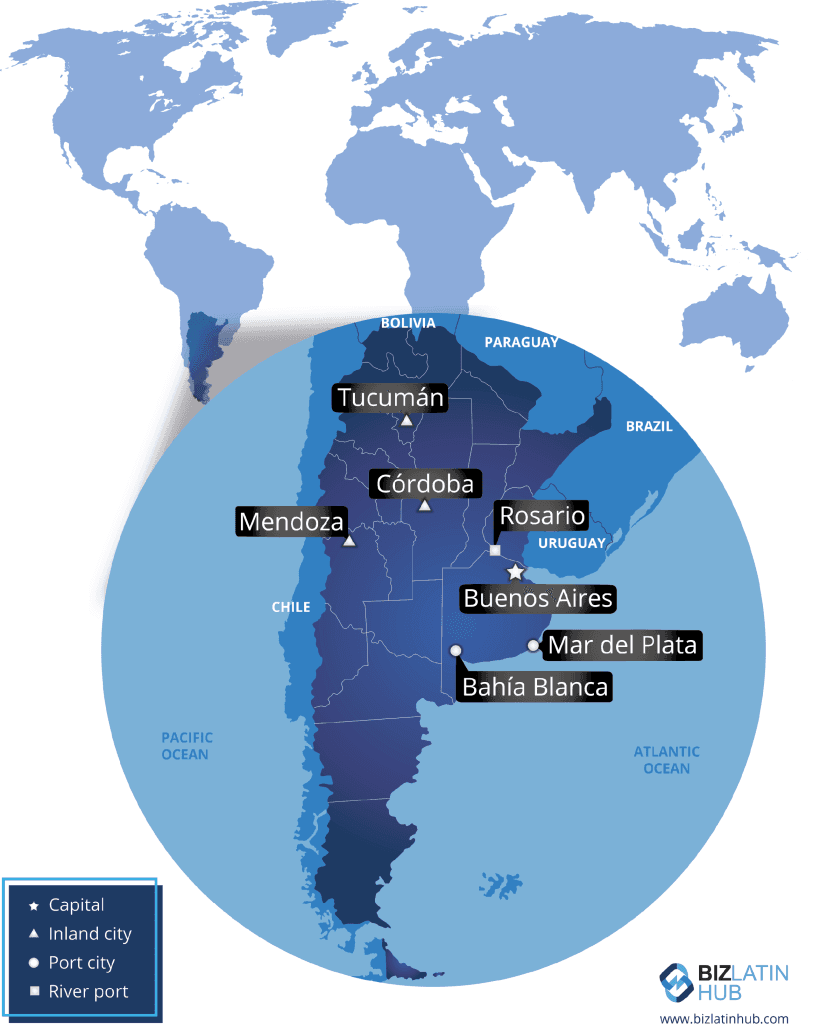
How to Form a Branch in Argentina: a 5 Step Guide

If you want to start doing business in Argentina, the first thing you will need to do is to decide which type of entity best suits your needs.

On this page

  • Argentina – What is a branch office in a foreing country
  • Branch office registration requirements
  • Step 1: Qualification report
  • Step 2: Documents of proof
  • Step 3: Notice in the Official Gazette/Official Journal
  • Step 4: Signed document by the representative
  • Step 5: Payment of the registration fee
  • Additional documentation
  • How to obtain a tax number?
  • Register a Branch in Argentina with the help of Biz Latin hub

If you want to start doing business in Argentina, the first thing you will need to do is to decide which type of entity best suits your needs. If you have an established brand elsewhere and would be keen to avoid going through full company formation, an attractive option is to register a branch in Argentina.

An overview over the South American nation, a perfect place to open an Accounting Firm in Argentina

Argentina registered a gross domestic product (GDP) of $449,7 billion in 2019 (all figures in USD unless otherwise stated) and is the third-largest economy in Latin America, behind Brazil and Mexico. Argentina is also one of the main recipients of foreign direct investment (FDI) in the region, registering FDI inflows of $6.66 billion that same year.

Argentina is a co-founder of the Southern Common Market (Mercosur), a regional integration process, that has recently celebrated its 30th anniversary. Argentina founded this association with Brazil, Paraguay and Uruguay.

Argentina is an attractive market for foreign investors as it has the highest English proficiency and literacy rate among non-English speaking countries in Latin America and the Caribbean.

The top exports of Argentina are soybean, corn, delivery trucks, exporting mostly to Brazil, China, and Chile.

If you are considering doing business in the country, read on to learn about the advantages on offer if you register a branch in Argentina, as well as the steps involved in doing so. Or go ahead and reach out to us now to discuss your market entry options.

Argentina – What is a branch office in a foreing country

Share this guide

More guides for Argentina

Business opportunities in Argentina for 2025Auditor in Argentina: Why do you need one?Fast and Efficient Business Formation with Shelf Companies in ArgentinaInflation in Argentina and the Effect on BusinessHow to find a headhunter and IT recruitment in Argentina?

More guides for Argentina

Business opportunities in Argentina for 2025
Company FormationBusiness opportunities in Argentina for 2025
Auditor in Argentina: Why do you need one?
Tax & AccountingAuditor in Argentina: Why do you need one?

Let’s talk about your expansion

Tell us which markets you’re entering and what you need handled. A local specialist will map out your options — no obligation.

Get in touchTalk to an expert

Trusted by teams expanding across Latin America and the Caribbean

Talk to a Latin America market-entry specialist

A branch office is very simple to define but may be more difficult to understand. It is simply any affiliated location to a company or business entity, that is not the head office, meaning that it is the head office that carries all legal responsibility. Despite being exempt from legal responsibility, a branch must have its own capital, its own legal representative and its own legal address and list of shareholders.

The cost of setting up a branch of a company in Argentina is between USD$400-500 and must be done before the Public Registry of Commerce.

Infographic titled "Doing Business in Argentina" with a map of Argentina. It states a population of 44.9 million, GDP of $445.4 billion, GNI of $11,130 per capita, and FDI inflows of $6.66 billion. Major exports are animal fodder, cereals, vehicles, fats, oils, and meats.

Branch office registration requirements

To establish and register a branch of a foreign company in Argentina you will need the following documentation:

Step 1: Qualification report

This must be issued by a local notary or lawyer. Their signatures must be certified by one of the Argentine Notaries Public or BAR associations. The report must include:

  • Legal minimum and maximum rules applicable to the meeting and to the company’s management body
  • Principal location of the business (‘domicilio fiscal‘)
  • A statement from the public notary or lawyers with the company’s book information.

Step 2: Documents of proof

  • The articles of formation or incorporation, by-laws and amendments
  • A certificate of good standing, registration and authorization to do business (issued in the home country)
  • The resolution of the company’s governing body, including the fiscal year end, the location of the company’s principal place of business, capital assigned to the branch, and the appointment of a legal representative.

Step 3: Notice in the Official Gazette/Official Journal

Which must include:

  • the principal place of business, the capital assigned and the date of closing of the fiscal year
  • the appointed legal representative must include personal information, registered address and term of representation.

Step 4: Signed document by the representative

The document must be certified by a notary public or by the corresponding association. In the case of the representative being an accountant or a lawyer, the representative must:

  • accept the appointment and provide personal information
  • establish the principal place of business in Argentina
  • establish his/her registered address within the relevant jurisdiction

Step 5: Payment of the registration fee

There is a registration fee for branch offices. The final step to set-up a branch of a foreign company is to show proof of the payment.

Additional documentation

A close-up image of a pencil and a calculator placed on an open notebook with handwritten numbers. The grid paper suggests work related to calculations or accounting, potentially at a branch in Argentina. The focus remains on the pencil and calculator, highlighting meticulous record-keeping.

Some additional documents are needed to prove that:

  • The company is not prevented from carrying out its businesses in its home country
  • The company is already established outside of Argentina

Once the branch office is established, it must obtain a tax number (CUIT) to begin operations.

How to obtain a tax number?

To obtain a tax number, known as a C.U.I.T (Clave Única de Identificacion Tributaria) (Unique Tributary Identification Code) you must apply for the tax number at the Argentine tax authority AFIP (Administración Federal de Ingresos Públicos) (Federal Administration of Public Income).To administer all the accountancy of the company, it is highly recommended that you hire a local accountant who can assist you.

Each company in Argentina must show an accountancy balance each year and will pay the same amount of taxes as any other company in Argentina. This is 45% in income tax and 25% VAT.

Register a Branch in Argentina with the help of Biz Latin hub

At Biz Latin Hub, our multilingual team of company formation experts can help you register a branch in Argentina to take advantage of business opportunities in the country. With our full suite of accounting, recruitment, legal, and tax advisory services, we can be your single point of contact to register and manage any type of legal entity in Argentina, or any of the other 15 countries across Latin America and the Caribbean where we are present.

Contact us now to find out how we can assist your business.

Or learn more about our team of expert authors.

Infographic titled "Our Services" with icons pointing to six services provided by BizLatin Hub: Accounting & Taxation, Company Formation, Commercial Representation, Legal Services, Hiring & PEO, and Visa Processing. Need to register a company in Costa Rica? Contact and website details are at the bottom.
Nearshoring in Argentina: What are the benefits?
How to Open a Corporate Bank Account in Argentina: A Guide
Doing Business in Argentina in 2025 – Opportunities, Challenges & Market Entry Insights

On this page

  • Argentina – What is a branch office in a foreing country
  • Branch office registration requirements
  • Step 1: Qualification report
  • Step 2: Documents of proof
  • Step 3: Notice in the Official Gazette/Official Journal
  • Step 4: Signed document by the representative
  • Step 5: Payment of the registration fee
  • Additional documentation
  • How to obtain a tax number?
  • Register a Branch in Argentina with the help of Biz Latin hub
Fast and Efficient Business Formation with Shelf Companies in Argentina
Company FormationFast and Efficient Business Formation with Shelf Companies in Argentina
Inflation in Argentina and the Effect on Business
Company FormationInflation in Argentina and the Effect on Business