Company Formation
Incorporate a Company in Peru: A Step-by-Step Guide
Published dateDecember 10, 2019
Last updateDecember 4, 2025
Reading time13 minutes

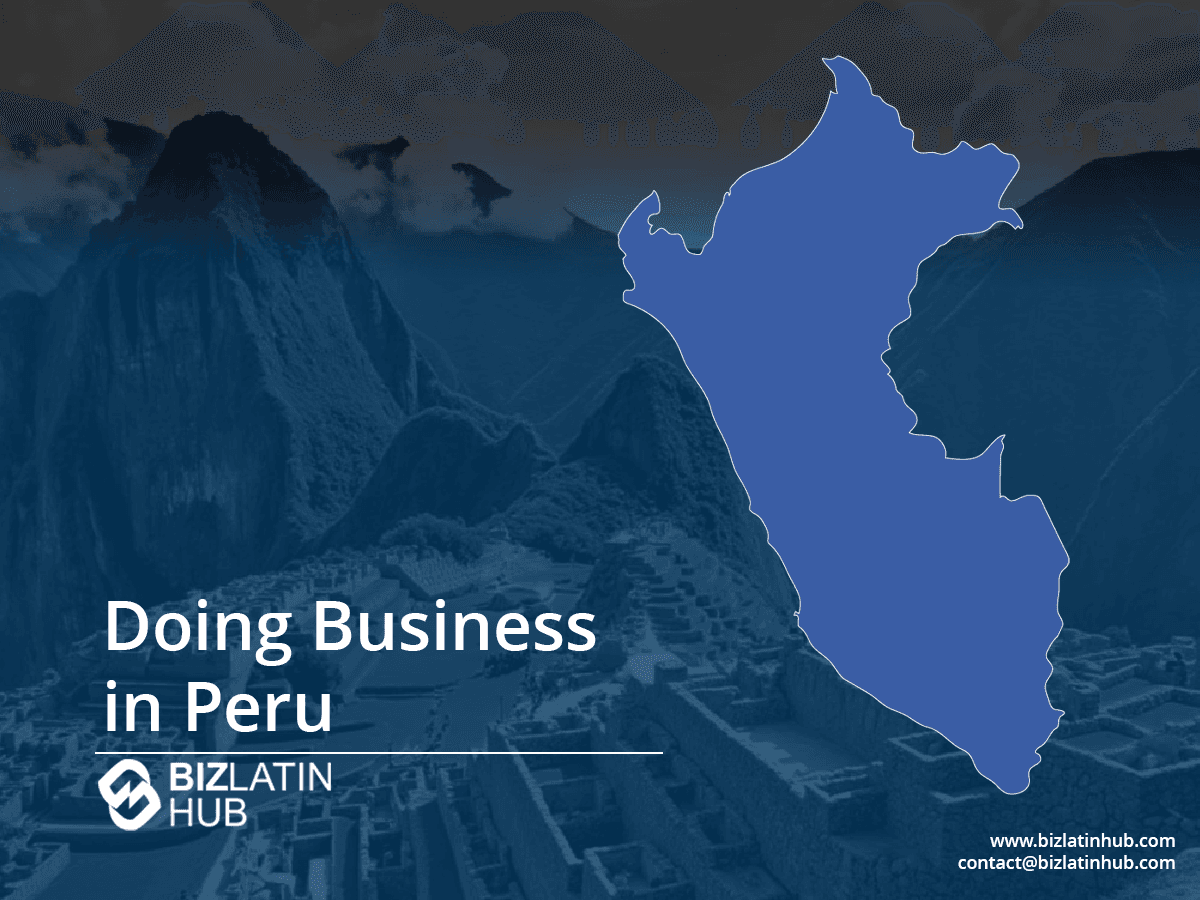
As an investor, looking to incorporate a company in Peru can allow you to take advantage of the opportunities the country offers.
Key takeaways
Is Foreign Ownership Permitted in Peru?
100% foreign ownership is allowed in Peru, however you will need local representatives.
Steps to Incorporate a Company in Peru:
Step 1 – Understand the types of legal entities available. • Step 2 – Appoint a legal representative. • Step 3 – Choose Your Company Name. • Step 4 – Identify Your Shareholders. • Step 5 – Establish a Fiscal Address. • Step 6 – Prepare and Sign the Public Deed. • Step 7 – Register for Your Tax ID. • Step 8 – Open a Corporate Bank Account and Deposit Your Company Share Capital. • Step 9 – Legalize
What are the most common entity types (SAC vs. SRL)?
Closely-Held or ‘Closed’ Corporation (Sociedad Anónima Cerrada or SAC) • Open Stock Corporation (Sociedad Anónima Abierta or SAA) • Limited Liability Company (Sociedad de Responsabilidad Limitada or SRL) • Branch Office (Sucursal) • Individual Company of Limited Responsibility (Empresa Individual de Responsabilidad Limitada, or EIRL).
Why Set Up a Business in Peru?
The government continues to pass legislation that makes the commerical environment lucrative for foreign investment.
As an investor, looking to incorporate a company in Peru can allow you to take advantage of the opportunities the country offers. When supported by the right expertise, starting a business in Peru is a straightforward process, ensuring compliance with the country’s well-defined rules and procedures. This involves registering with the commercial registry known as SUNARP as part of company formation in Peru. For ongoing term fiscal compliance you will be dealing with the tax authority SUNAT, so you will also have to register with them for an official tax number. This guide details the legal and tax procedures required to establish a formal subsidiary or new business in Peru.
How to Incorporate a Company in Peru – Step-by-Step Guide
- Step 1 – Understand the types of legal entities available.
- Step 2 – Appoint a legal representative.
- Step 3 – Choose Your Company Name.
- Step 4 – Identify Your Shareholders.
- Step 5 – Establish a Fiscal Address.
- Step 6 – Prepare and Sign the Public Deed.
- Step 7 – Register for Your Tax ID.
- Step 8 – Open a Corporate Bank Account and Deposit Your Company Share Capital.
- Step 9 – Legalize Your Company’s Accounting Books.
Company incorporation in Peru typically takes 4–6 weeks if everything is in order. However, if special licenses or permits are needed for certain fields, this can delay the process.
Business in Peru: Why You Should Incorporate a company in Peru.
1. Understand the types of legal entities available
When you start a business in Peru, you must choose the type of legal entity you wish to create. These include:
- Closely-Held or ‘Closed’ Corporation (Sociedad Anónima Cerrada or SAC)
- Open Stock Corporation (Sociedad Anónima Abierta or SAA)
- Limited Liability Company (Sociedad de Responsabilidad Limitada or SRL)
- Association
- Foundation
- Branch Office (Sucursal)
- Individual Company of Limited Responsibility (Empresa Individual de Responsabilidad Limitada, or EIRL).
Most experts recommend that new investors create a Closely-Held Corporation (SAC) when expanding into Peru. Because a formal “Board of Directors” structure is not mandatory, a SAC allows for easier decision-making and facilitates business activities.
When you incorporate a SAC in Peru, transferring shares is also faster because the final shareholders don’t need to be registered with the Public Registries. This means that there are less costs involved in the registration process. When you incorporate a company in Peru, choosing to create a SAC will facilitate the process.
All companies interested in doing business in Peru must be aware of the country’s company incorporation requirements, to ensure they remain in good standing with local governmental authorities.
Note: be aware of the regulations specific to your legal entity
Once you have decided on the legal entity that best suits your company, you must follow the steps outlined below. They provide information on how to finish incorporating a company in Peru in accordance with local corporate laws.
Depending on your company’s commercial activities, you may have to adhere to additional corporate compliance obligations. Therefore it is reccommended that you confirm with a local lawyer with experience registering companies in Peru.
Comparison of SA and SRL in Peru:
Entity name — S.R.L — S.A
Type of legal structure — Limited Liability Partnership — Corporation
Foreign ownership permitted? — Yes, 100% — Yes, 100%
Number of shareholders? — Minimum 2, maximum 20 — Minimum 2, maximum • 20
Limited liability? — Liability of the partners is limited to their capital contributions — Liability of the shareholders is limited to their capital contribution, represented in the shares.
Minimal capital? — Zero — Zero

2. Appoint a legal representative
In Peru, a legal representative acts as the legal face of the company before government authorities. The legal representative must make all the decisions on behalf of your company on legal matters. As such, the person appointed as legal representative holds certain legal liabilities.
The appointed individual must be either a local national or a foreign national with a valid Peruvian visa. All companies wanting to incorporate in Peru must have a legal representative.
3. Choose Your Company Name
Once you have appointed a legal representative, you can select and reserve your company name. The government authority in charge will confirm if your preferred name is available. In Peru, this is done by the National Superintendency of Public Registries, known locally as SUNARP.
To ensure you get your preferred company name and avoid any delays, it is best to provide three potential name options for SUNARP to review.
4. Identify Your Shareholders
Every legal entity in Peru must have at least 2 shareholders and a maximum of 20 shareholders. They can be foreign individuals or other legal entities.
5. Establish a Fiscal Address
Another important step when incorporating a company in Peru is establishing a fiscal address.
You must register your company with a fiscal address within Peru in order to receive correspondence from government authorities.
6. Prepare and Sign the Public Deed
To register your company with the Peruvian authorities you will need to create a public deed. This is done by creating a draft of the constitution act and having it reviewed and approved by a Public Notary. Once approved, the Public Notary and all company owners (if there are multiple) must sign and stamp the deed.
You must present the completed public deed before the SUNARP.
7. Register for Your Tax ID
Every legal entity must be registered with the national tax authority, and get its own tax identification number. This number is known as a Registro Único de Contribuyentes (RUC). The agency responsible for this in Peru is the National Superintendency of Tax Administration (Superintendencia Nacional de Administración Tributaria, or SUNAT).
Expert Tip: Activating the RUC
From our experience, obtaining the RUC number is only half the battle; you must also “activate” it. This requires the legal representative to verify the fiscal domicile. Often, SUNAT requires a utility bill (water or electricity) in the company’s name or a notarized lease agreement. Furthermore, the legal representative must enter the “Clave SOL” (online tax password) system to confirm the start of activities. We advise ensuring your registered office documentation is perfect to avoid delays in activating your RUC status.
8. Open a Corporate Bank Account and Deposit Your Company Share Capital
Peruvian law doesn’t require a minimum share capital for new companies. However, to formalize your company, you need to deposit your desired share capital amount in a Peruvian bank.
This will also enable you to open and activate a corporate bank account, which is crucial before a company can start operations in Peru.
To open a bank account, you will need to provide your company’s information. To save yourself time, consult a local lawyer in Peru to find out what documentation you need and how to prepare it properly.
It is recommended you open a bank account with at least S/500.00, but exact rules depend on the bank you choose.
9. Legalize Your Company’s Accounting Books
The final stage when incorporating a company in Peru is legalizing the company’s accounting books.
If your company chooses to issue electronic accounting books, you can present them to the SUNAT via their online platform.
If you choose to work with physical accounting books, check with your Peru accounting consultant on how the legalization process works.
After completing this process, your new company will be successfully incorporated and ready to begin operations in Peru.
Peru Company Registration Requirements for Foreign Businesses
The following are the requirements for forming a Private Closed Corporation (S.A.C.) in Peru:
- Shareholders: Requires a minimum of two and a maximum of 20 shareholders. Shareholders can be individuals or legal entities, either Peruvian or foreign.
- Board of Directors: Unlike the S.A., a Board of Directors is not mandatory for an S.A.C. However, the company must appoint a General Manager to oversee operations.
- Liability: Shareholders’ liability is limited to their contributions, ensuring their personal assets are protected.
- Share Transfer Restrictions: Shares cannot be freely traded and are subject to transfer restrictions, ensuring the company retains its “closed” nature.
- Legal Requirements: A fiscal address in Peru is mandatory. Registration with SUNARP is required. A Peruvian resident legal representative must be appointed, either national or foreign resident. This can be done via POA.
- Taxation: Subject to corporate income tax on worldwide income if domiciled in Peru.
Capital and bank account setup
In order to open an account in Peru for an SAC, there is no minimum capital requirement, but the bank may request a certain sum. The documents generally required are the following:
- Copy of the company’s incorporation certificate.
- Verbatim copy of the company’s incorporation, issued by the registry authority, not less than 30 days after it is issued (the term of issuance depends on the banking entity).
- RUC card, issued by the tax authority.
- Power of attorney of the legal representative.
- Identity document of the legal representative: DNI or Peruvian identity card.
- Opening file: signature registration form, letter of instruction.
- Make the minimum deposit required for local or foreign currency.
Once you have prepared the documents required by your bank, you may request the opening of an account. The documents provided by your company will prove the existence of the company and its recognition by the Public Register and the National Superintendency of Taxation Administration (SUNAT). The bank will validate them and determine whether your application is successful.
You should note that even if the documents are valid, a personal or corporate account may be turned down if the applicant has a bad credit rating. If you are successful, your account will be opened and you will be sent the details to activate the online banking.
Peruvian taxation overview
Generally speaking, Peru has a stable tax and financial reporting framework, which is favorable for investment since foreign companies can plan more confidently than other countries. From a tax perspective, all companies registered in Peru are considered residents of Peru and have to pay taxes to the national tax authority, SUNAT.
They are subject to a corporation tax rate of 29.5% and to meet their annual corporation tax liability, entities must make monthly advanced payments on account calculated as 1.5% of their monthly revenue. At the end of the year, the company simply deducts these advance payments on account of their total corporation tax liability to determine the balance payable.
Companies listed on the local stock exchange (SMV – Superintendencia de Mercado de Valores) must apply full IFRS whilst all other companies must follow the General Business Accounting Plan based on IFRS but less rigorous in its discloser requirements.
Peru uses the so-called “tax unit” (UIT), the amount is determined each year by the Peruvian Ministry of Economy and Finance.
- Corporate tax: 29.5%
- VAT: 18%
- Monthly filing requirements
- RUC registration with SUNAT
- Payroll/social security compliance with EsSalud
The Role of SUNAT
The National Superintendence of Customs and Tax Administration (SUNAT) is the government agency responsible for taxation. Obtaining a RUC (Single Taxpayer Registry) number from SUNAT is essential for any commercial activity, including opening bank accounts and invoicing.
FAQs About Company Formation in Peru
According to our experience, these are the most common questions and doubts of our clients about company formation in Peru.
1: What is the process to incorporate a company in Peru?
Incorporating a company in Peru involves choosing a legal structure (most often an SAC), drafting and notarizing the bylaws, reserving the company name with SUNARP, registering the entity with the Public Registry, obtaining a RUC (tax ID) from SUNAT, and opening a corporate bank account.
2: What types of companies can foreign investors register in Peru?
The most common types include the Sociedad Anónima Cerrada (SAC), which allows up to 20 shareholders and is ideal for SMEs; the Sociedad Anónima (SA), used for larger operations; and the Sociedad Comercial de Responsabilidad Limitada (SRL). SAC is the preferred structure due to its flexibility and streamlined setup.
3: What is a SAC?
A SAC (Sociedad Anónima Cerrada) is a Closed Corporation. It is the most popular structure for foreign investors, requiring a minimum of 2 and a maximum of 20 shareholders.
4: How long does it take to register a company in Peru?
The company formation process in Peru generally takes 4 to 6 weeks, depending on the notarization, registry times, and whether foreign documents require apostilles and translations.
5: What are the requirements to start a business in Peru?
You will need at least two shareholders, a local legal representative, a fiscal address, notarized bylaws in Spanish, and registration with SUNARP and SUNAT. Foreign shareholders must present apostilled identification documents.
6: What are the tax obligations for companies in Peru?
Corporate income tax is 29.5%. Companies must also comply with VAT at 18%, monthly tax filings, and payroll contributions if hiring employees. Businesses are required to register with SUNAT for a RUC and maintain accounting records in Spanish.
7: What is SUNARP?
SUNARP is the National Superintendence of Public Registries. It manages the registry of all companies (Personas Jurídicas) in Peru.
8: What are the statutory books?
Companies must keep official books, including a Minute Book, Shareholder Register, and accounting books. These must be legalized by a notary public.
9: Is there a minimum capital?
There is no strict legal minimum capital (except for banks, etc.), but financial institutions typically require at least PEN 1,000 (approx. USD $270) to open a corporate account.
Key Benefits of Incorporating in Peru
Ease of doing business in Peru is one of the main factors foreigners take into consideration when choosing this destination for either direct or indirect investment. There are no restrictions for foreign shareholders, foreign investment, foreign exchange or the remittance of profits.

Recently, legislation has also been passed that facilitates foreign investment and ensures foreign and local companies are treated equally. Moreover, incorporating a company in Peru is a relatively straightforward process. All of these highly competitive conditions are worth exploring to make the most of what this growing nation has to offer.
Government investments in Science, Technology, Engineering and Mathematics (STEM) education over the past decade have paid off, and Peru now has a thriving tech scene. It ranks in the top 10 countries with the highest per-capital levels of tech entrepreneurial activity (1 in 4 Peruvians have started a business in the past four years).
Whether it is foreign companies or entrepreneurs who want to start a business in Peru, or are thinking of hiring software developers there, the jurisdiction has never looked better, with the strong growth predicted to continue for at least the rest of the decade.
There are currently four Free Trade Zones in the country, with a further four being developed. These zones are overseen by the Ministry of Commerce and offer tax exemptions, simplified customs processes and specialized on-site exportation and importation support. Specific zones also offer particular perks for certain industries.
Legal Stability Agreements are available to investors who meet the minimum legal amounts. In addition, the company incorporation process in Peru is relatively simple and straight-forward. The most frequent company structures are the corporation and the limited liability company; both protect the shareholders up to a certain extent.
Biz Latin Hub can help you incorporate a company in Peru
Peru has a promising year ahead in 2023, and the goverment is making an effort to bolster the economy and attract foreign investment. This sets the stage for continued economic growth and success for businesses in the country.
Take advantage of this period of growth by getting expert support for the incorporation of your company in Peru. At Biz Latin Hub, our Peru team is equipped with a depth of expert knowledge on how to incorporate a company in Peru. With our assistance ensure you have everything you need to enter this market.
We customize our suite of multilingual market entry and back-office services so your company can start off on the right foot and within the parameters of local law. For more information on how we can assist you with your company incorporation in Peru, reach out to us here at Biz Latin Hub today.
Learn more about our team and expert authors.

Share this guide


Let’s talk about your expansion
Tell us which markets you’re entering and what you need handled. A local specialist will map out your options — no obligation.
Trusted by teams expanding across Latin America and the Caribbean
