Compliance and Security
How does trademark enforcement in Latin America work?
Published dateOctober 22, 2019
Last updateAugust 28, 2024
Reading time11 minutes
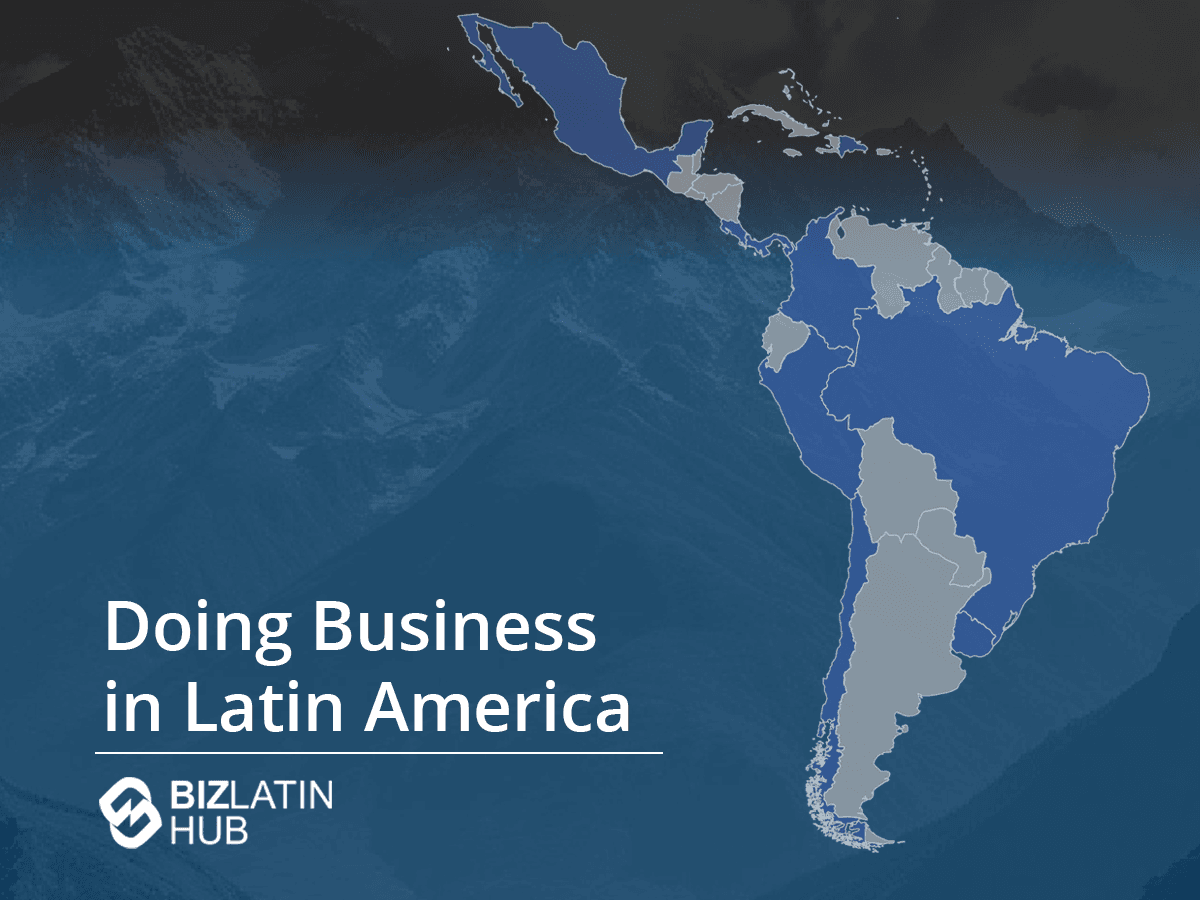
Trademark enforcement in Latin America follows a set of laws and international treaties. The Global Innovation Index 2023 (GII) developed by the World Intellectual Property Organization (WIPO) measures an economy’s innovation performance.
Trademark enforcement in Latin America follows a set of laws and international treaties. The Global Innovation Index 2023 (GII) developed by the World Intellectual Property Organization (WIPO) measures an economy’s innovation performance. The GII ranks Brazil as the most innovative Latin country, with Chile and Mexico close on their heels.
The Pacific Alliance member countries Chile, Colombia, Mexico and Peru benefit from the Patent Prosecution Highways (PPH) agreement, which makes patents from member countries eligible for expedited review in the Pacific Alliance. Trademark enforcement in Latin America is becoming increasingly better regulated in recent years as the region continues to modernize.
We outline the importance of registering your intellectual property in Latin America, and your right to take action to protect your business. At Biz Latin Hub we can help you with trademark enforcement in Latin America and make sure that your business is fully protected. Our network of 18 dedicated local offices throughout the region means we can help you anywhere with our range of legal services.
Importance of intellectual property and trademarks in Latin America
Registering a trademark is one of the most important elements of a business. Registering a brand shows who has created it, and provides legal protection and rights over the commercialization of the brand or product by other parties.
Registering a brand or patenting a product differentiates your business against competitors, which is of great importance if your business model intends to follow the differentiation strategy. Latin American countries have been implementing measures to offer greater protection and facilitate trademark enforcement globally.
The benefits of protecting your creative works include:
- Exclusive rights, generally this allows your company to exploit the invention exclusively for up to 20 years
- Protection against copy issues from competitors
- Higher returns on investments from commercialization of the invention
- Opportunity to license or sell the invention
- Increased negotiating power
- Prestige/brand development.
Almost every small- or medium-sized enterprise (SME) has a commercial name that should be considered for patent protection. SMEs have valuable assets, including client lists, commercial strategies, original graphic designs and creations. Furthermore, some SMEs may have contributed to inventions or to the improvements in a service.
For all the above-mentioned cases, a business should understand the best way to utilize the intellectual property (IP) system of the country they operate in to get ahead of competitors.
Legal rights to enforce trademarks in Latin America
For the period of time your patent or trademark is registered, your invention or brand is protected and you have the support from local authorities to validate your rights. Also, you have the right to request administrative infringements and applicable sanctions, as outlined in your local intellectual property law.
In some cases, third parties are unaware of the infraction and don’t seek to be involved in disputes. For these situations, a warning letter specifying the rights you have over your patent, and the possibility to take legal action may suffice to discourage people from using your marks.
To protect your patent it is important to have solid bases and determine the product precisely. Specifications for your product classification could be required to include shape, nominative values, unnamed tags for graphics, and more, but these vary as per requested by each country.
Chile has been a trailblazer for trademark enforcement in Latin America
Chile was for many years the leading country in the region for IP protection. The nation has advanced in institutional variables related to education, including patents, utility models and app creation. Additionally, Chile is a member country of WIPO, which facilitates trademark enforcement in other member countries of the organization.
The nation continues to improve its IP processing system. On 1 October 2018, Chile incorporated the Digital Access Service (DAS). This electronic system facilitates the secure exchange of patent documents that have priority, models of utility, drawings and industrial designs between offices of the participating patents.
Trademark enforcement in Chile
Chile is a member of the Paris Convention and is party to the Agreement on Trade-Related Aspects of Intellectual Property Rights (TRIPs), but other trade agreements that include IP chapters are also valid. TRIPs regulate border measures and infringements found at borders can be followed by legal action in court.
Intellectual property issues in Chile are dealt with two different laws:
- Law N 19.039, known as Property Law that governs patents, trademarks and designs
- Law N 17.336, known as Copyright Law that governs copyrights
The actions available for enforcement are classified into criminal actions and civil actions. The Copyright Law contemplates criminal and civil action; whereas, the Industry Property Law only contemplates criminal actions.
Civil infringement actions are possible under the Unfair Competition Law (20.169) and the Copyright Law. For civil actions, the court is in charge of prosecution and deciding on compensation for damages. Penalties may be established according to the trademark owner’s suggestions. These sanctions could focus on profits that the owner missed due to infringement, profits the infringer received from the violation, or the financial value of a license.
To open a criminal action, registered trademarks should be displayed in the form of Marca Registrada (Registered Trademark), MR, or ‘®’. Criminal actions are open when a third party used in bad faith a registered trademark for products that are highly similar or identical to the original. A court can dictate destruction or donation of tools, products, materials, and a fine for infringement.

Mexico and the USMCA agreement on IP
The Mexican Institute of Intellectual Property (IMPI) has powers to promote and protect innovation through their industry property system. Also, Mexico is a member of the WIPO through the Madrid System, which permits easier trademark enforcement within the member countries.
Due to Mexico’s importance to global trade, the country’s leading patent variables are related to trade. As a member of the US-Mexico-Canada Agreement (USMCA), Mexico is deeply tied to North American negotiations on trade. Recent USMCA discussions touched upon IP protection for companies doing business in the continent, and included an extension that benefits Canada and Mexico.
Chapter 20 of the USMCA requires the extension of data protection to 10 years for biologics, which impacts the pharmaceutical industry as it provides more time for the exclusivity of their data while they develop new drugs. This chapter may be referred when addressing a dispute in Mexico as it covers more topics of trademark enforcement.
Protecting your trademark in Mexico
Infringement claims are filed before the IMPI. After the claim has been filed the IMPI will notify the defendant, who must file a reply.
Since the IMPI is not a court, it can only dictate infringers to pay a fine and stop reproducing or using the disputed trademark. On the other hand, you can file an action in the civil court to claim damages, only if the IMPI has made a final declaration. The damage claim is a least 40% of the financial value of the infringed products.
It is possible to protect your patent while you prepare for legal actions. During or before the prosecution it is possible to request that infringement actions be stopped, in accordance with the industrial Property Law. This is known as ‘temporary injunction’.
Criminal actions may be filled when the unauthorized products are identical to the original. If the Attorney General’s Office confirms that the items are counterfeit, the issue will be deferred to the Federal District Court. Criminal penalties range from 2 to 10 years of imprisonment and fines up to USD$100,000. Investors interested in patenting their products or brand must follow the Mexican legislation with assistance from local trade lawyers.
Brazil IP Regulations
Brazil is now leading the region in technology and entrepreneurship. Brazil’s remarkable variables in patenting are related to investment in research and development and it is a leader in trademark enforcement in Latin America.
Listed in the official website of the National Institute of Industrial Property (INPI), there are 6 general laws and treaties that touch upon IP and describe specifications per case.
The 6 laws and treaties are:
- Law 9.279: Regulates the rights and obligations related to Industrial Property.
- Copyright Law No. 9.610 / 98: Modifies, updates and consolidates the copyright law and establishes other provisions.
- Law No. 5.648: Creates the National Institute of Industrial Property and other measures.
- Decree No. 8,854: Approves the Regulatory Structure and the Demonstration Table of the Commission Positions and Trust Functions of the National Industrial Property Institute.
- Ordinance No. 11: Approves the Internal Regulations of the National Institute of Industrial Property (INPI).
- Paris Union Convention.
The incorporation of Brazil to the WIPO is relevant as it is considered a big economy in the region. Brazil joined the WIPO’s International Trademark System in July of 2019 through the Madrid Protocol. The system entered into force on 2 October 2019. Now, brand owners from the world will benefit from convenience and reduced costs to protect their brands in Brazil.

Taking legal actions in Brazil
An infringement action can be filed by the trademark owner or by the licensee. The latter can only open an infringement action if it is included in its license agreement and if the licensee is registered with the Brazilian Patent and Trademark Office (BPTO). Border measures in Brazil are dealt by the Internal Revenue Service (IRS) through its network of Custom Offices located in ports, airports and land borders.
The enforcement proceedings are categorized into civil and criminal.
For civil proceedings, a trademark holder can file an infringement action or a nullity action for revocation of trademarks. Nullity Infringement against trademarks requests the annulment of an act, and these actions fall under the federal jurisdiction.
Criminal offences are exhibited in the Industrial Property Act (BIPA), and specify sanctions of imprisonment for a timeframe of three months to one year, or a fine and the possibility of penalty extension.
Peruvian IP regulations

Peru is a country with strong partnerships over the region and other Pacific countries. The nation is a member of the Pacific Alliance and the Comprehensive and Progressive Agreement for Trans-Pacific Partnership (CPTPP). These partnerships create fluidity in trade within the member countries.
In 2018, Peru joined the WIPO through the treaty of Singapore, allowing member countries to protect their brands in Peru in an easier manner. The objective of this event is to harmonize and simplify processes to registry and manage marks and services, with the intention to offer Juridical protection to investors.
Local trademark enforcement
Administrative actions are brought before the Commission of Distinctive Signs of the National Institute for the Defense of Competition and the Protection of Intellectual Property (INDECOPI).
Compensation for damages can only be obtained through a claim before the civil court.
If it is determined that there has been an infringement, a fine and a cessation may be declared. On the other hand, judicial actions are dealt in the first instance criminal court that manages intellectual property rights. Border measures are handled by the Custom Authorities, they are an autonomous body of control that has its own Customs Law.
FAQs on trademark enforcement in Latin America
Biz Latin Hub can help with trademark enforcement in Latin America
To expand your company abroad, it is important to patent your ideas, inventions and unique commercial processes utilizing the IP regulations offered in each country in Latin America. Trademark enforcement in Latin America is different per country, so it is important to have a local trademark attorney that will help you protect your brand from infringement.
At Biz Latin Hub, our team of legal specialists can help you protect your patents in this developing region, and obtain the greatest commercial benefits from your products.
Contact us now for personalized advice and assistance.
Learn more about our team and expert authors.

Share this guide



Let’s talk about your expansion
Tell us which markets you’re entering and what you need handled. A local specialist will map out your options — no obligation.
Trusted by teams expanding across Latin America and the Caribbean
