Compliance and Security
What are Companies’ Requirements for Corporate Compliance in Bolivia?
Published dateSeptember 4, 2020
Last updateAugust 20, 2023
Reading time4 minutes
It is essential for foreign executives to know their obligations for corporate compliance in Bolivia. Understanding and complying with local law means being able to expand into Bolivia as smoothly as possible while remaining in good standing with local authorities.
It is essential for foreign executives to know their obligations for corporate compliance in Bolivia. Understanding and complying with local law means being able to expand into Bolivia as smoothly as possible while remaining in good standing with local authorities. Learn all you need to know about corporate compliance in Bolivia.
Types of companies and corporate compliance in Bolivia

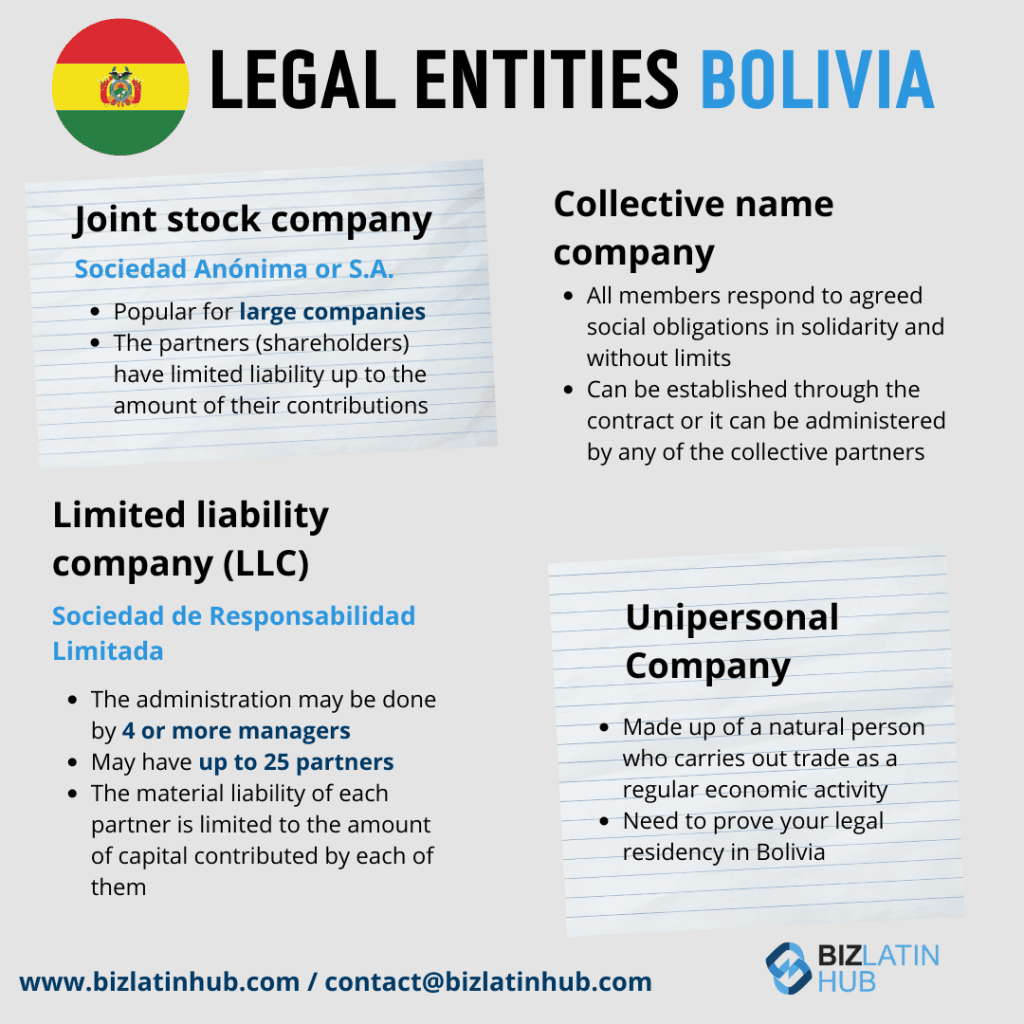
Foreign executives who decide to enter the Bolivian market must decide which type of company is the best option for their business. Likewise, they must prepare all the documents and requirements needed in order to register the company before the Trade Registry Office in Bolivia. The main types of companies in Bolivia include:
- Limited Liability Company LLC (Sociedad de Responsabilidad Limitada S.R.L.): This is the most common type and requires a minimum of 2 shareholders up to a maximum of 25.
- Corporation (Sociedad Anónima S.A.): Capital stock can be divided into shares that you can transfer, and in which partners are not personally liable for corporate debts. Moreover, a corporation requires a minimum of 3 shareholders and there are no restrictions on the number.
- A branch of a Foreign Company: The main company regulates the rules and assumes responsibility before third parties.
Once the company is duly registered, business owners must meet the corporate compliance requirements established in Bolivia. Some of these requirements include requesting the Tax Payer Number and the Operating license and opening a corporate bank account.
Requirements for corporate compliance in Bolivia
Legal entities in Bolivia must appoint a legal representative to declare the company’s will. The legal representative must be an individual, Bolivian or foreign, residing in Bolivia. This legal representative will represent the foreign shareholder before the Bolivian tax authorities and the government. To operate a business in Bolivia, a legal representative and a legal address must be guaranteed.
- Legal Representative: This natural person will be in charge of representing the company before third parties. They will receive and process any official communication.
- Legal Address: A company must register a legal address in Bolivia to operate, undergo inspections, and to receive official notifications.
Requirements established by the Commercial Registry

- Company Books: You have to register any general meeting assembly and shareholder’s information in the shareholders’ meeting book. A corporation in Bolivia must also have a ‘board of directors resolutions book’.
- Annual General Meeting: You must hold a meeting once a year approving the company’s Financial Statements.
- Registry Number Renewal: You must renew your Registry Trade Number every year according to dates listed in the following chart:
FISCAL YEAR CLOSURE — RENEWAL DUE DATE
December 31st — May 31st
March 31st — August 31st
Tax obligations for companies in Bolivia
Companies operating in Bolivia must obtain a Tax Identification Number (NIT) and declare all financial transactions to determine what taxes you must pay.
The three main taxes that any type of company must declare and pay are:
TAX — Declaration to Tax Office
VAT: A 13% tax is applied to the operations of the sale of goods and the provision of services. — Must be declared each month, according to the last digit of the company’s tax identification number.
TT (Transaction Tax): A 3% income tax is applied over any transaction. Likewise, a 3% income tax is applied without any discount.t. — Must be declared each month, according to the last digit of the company’s tax identification number.
BPT (Business Profit Tax): A tax of 25% is applied to the earnings obtained each year. — Must be declared each year, according to the fiscal year-end closing date determined by the company’s main activity.
Labor and social security compliance
Foreing executives doing business in Bolivia must comply with labor regulations, these include:
- National minimum wage is 305 dollars.
- Companies are required to make thirteen monthly salary payments (12 salaries + December Christmas bonus).
- The standard working time is 8 hours a day.
- Employees are entitled to 15 days of paid vacation.
Companies with employees must register at the Ministry of Labor, Pension Fund Administrator (AFP’s), and Health Public Insurance. Furthermore, contributions established by Bolivia’s Labor Laws will be calculated from each employee’s salary, as follows:
Contributions to be covered by the employer
Health Insurance= 10%
Contribution pro =2%
Professional risk = 1.71%
Employer contribution= 3%
TOTAL = 16.71% calculated from an employee salary
Engage with our specialists to discuss corporate compliance in Bolivia
Starting a business in Bolivia can be laborious, business owners must comply with local regulation to avoid risks and contingencies. At Biz Latin Hub, our team of legal and accounting specialists provides comprehensive company formation advice and guidance to support your expansion. With our full suite of bilingual market entry and back-office services, we are equipped to deliver excellence and ensure your business operations’ success in Bolivia.
Reach out to us now for personalized assistance.
Learn more about our team and expert authors.

Share this guide
More guides for Bolivia

Company FormationUnderstanding Bolivian Business Etiquette: Culture, Trust, and Communication

BankingOverview of Banking Innovation in Bolivia

Employment2025 Hiring Trends in Bolivia – Recruitment, EOR & Entity Setup Services
Company FormationHow to get the most from a headhunter and IT recruitment in Bolivia?
Let’s talk about your expansion
Tell us which markets you’re entering and what you need handled. A local specialist will map out your options — no obligation.
Trusted by teams expanding across Latin America and the Caribbean
