Company Formation
Set Up a Company in Ecuador: A Step-by-Step Guide
Published dateJuly 15, 2018
Last updateDecember 3, 2025
Reading time12 minutes

Starting a business in Ecuador involves a series of clear steps, beginning with granting the power of attorney with a trusted legal representative. There are plenty of opportunities for doing business in Ecuador, but you will need to understand how compliance works.
Key takeaways
Is Foreign Ownership Permitted?
Yes, a business can be 100% foreign-owned by either legal persons (legal entities) or natural persons (individuals) in Ecuador.
Steps to Register a Business in Ecuador:
Step 1: Grant power of attorney to the legal representative. • Step 2: Reserve the company name and complete documentation. • Step 3: Submit all the enabling documents to the authorities. • Step 4: Send the deeds and documents to the Commercial Registry. • Step 5: The tax authority will grant the company its tax identification number.
What are the main types of companies in Ecuador?
The SAS (Simplified Stock Company) is a popular new option. • • Limited Liability Company (S.R.L) • • Branch (Sucursal)
Why Set Up a Business in Ecuador?
Increases in foreign investment continues to stimulate the economy, with the incorporation process achievable online or offline.
Starting a business in Ecuador involves a series of clear steps, beginning with granting the power of attorney with a trusted legal representative. There are plenty of opportunities for doing business in Ecuador, but you will need to understand how compliance works. The body responsible for company formation in Ecuador is the Superintendencia de Compañias (Supercias) and you will also have to deal with the SRI, the tax authority. With the right expertise, the process to set up a company in Ecuador is straightforward and achieve success across various sectors. This guide details the legal framework and administrative steps required to establish a business entity in Ecuador.
How to Incorporate a Company in Ecuador – Step-by-Step Guide
These are the 5 steps that describe the process to set up a business in Ecuador. The process should take from 2-4 weeks if all the documentation is in order and there are no bureaucratic delays.
- Step 1: Grant power of attorney to the legal representative.
- Step 2: Reserve the company name and complete documentation.
- Step 3: Submit all the enabling documents to the authorities.
- Step 4: Send the deeds and documents to the Commercial Registry.
- Step 5: The tax authority will grant the company its tax identification number.
How to Set Up a Company in Ecuador.
1. Grant power of attorney to the legal representative.
Ensure that the shareholders grant power of attorney to their legal representative, permitting them to set up the company in Ecuador on their behalf.
Expert Tip: Appointment of the Legal Representative
From our experience, a key requirement for obtaining the RUC is the proper registration of the legal representative’s appointment. The appointment document must be registered in the Mercantile Registry before presenting it to the tax authority (SRI). Additionally, if the legal representative is a foreigner, they must have a valid Ecuadorian visa and ID card (cédula). Without a resident legal representative, the process halts.
2. Reserve the company name and complete documentation.
The legal representative, will then start the setup process before the Superintendency of Companies, Securities, and Insurance. If completing the process online, the legal representative will reserve the company name, and fill out documentation with all the required information about the company. This includes fiscal/legal address, president, general manager, name of the shareholders, and how much each shareholder holds in the company.
3. Submit all the enabling documents to the authorities.
Once the application is ready, it must be submitted with all the enabling documents to the Superintendency of Companies, Securities and Insurance for approval. For certain types of companies, once the company formation is approved, it is also necessary to register with the Mercantile Registry to complete the process.
4. Send the deeds and documents to the Commercial Registry.
The notary will send the deeds, documents and all the necessary information to the Commercial Registry.
5. The tax authority will grant the company its tax identification number.
If approved, the company will be registered. The tax authority will grant the company its tax identification number (RUC). At this point, the company is legally incorporated.
Types of Companies You Can Form in Ecuador
After deciding to start the company formation in the Ecuador process, the first step involves selecting the best type of legal entity to suit your business needs and goals. The most common types of legal entities are outlined below:

- Simplified Stock Company (Sociedad por Acciones Simplificadas S.A.S): This type of company facilitates the incorporation of a company by simplifying procedures, costs and allowing for a flexible corporate structure. It is designed to help smaller businesses enter the market quickly and bypass heavy bureaucracy. The S.A.S are companies where the ownership can be by a sole person. It requires a legal representative to be appointed within the company bylaws, a fiscal address, and no minimum capital.
- Limited Liability Company (S.R.L): Suitable for small and medium-sized businesses. The purpose of an S.R.L is to protect the personal assets of its members. The members of the company are only liable for the amount of their contributions. This type of company is usually created for a specific purpose of commercial or civil economic activity, with no banking, insurance, capitalization, or savings operations allowed. It can be incorporated with a minimum of 2 and a maximum of 15 shareholders and requires a minimum capital of USD$400.
- Branch (Sucursal): In Ecuador, a foreign entity may be domiciled in the country as a secondary establishment or branch. In this case, it will continue to be dependent on the parent entity, but will have legal presence in the country, including a tax domicile and an attorney-in-fact who will act as representative of the foreign branch.
Differences between an S.A.S and an S.R.L:
S.A.S (Sociedad por Acciones Simplificada) — S.R.L (Sociedad de Responsabilidad Limitada)
Number of shareholders — One to an unlimited number — At least two partners, maximum fifteen
Shareholders’ General Meeting — General Assembly of Shareholders; resolutions by absolute majority — General Meeting of Partners; resolutions by absolute majority
Board of directors — Not mandatory; one or more administrators — Mandatory; two or more administrators
Legal representative — Can be removed or replaced without specific cause — Must comply with legal obligations; can be removed or revoked
Duration — Unlimited — Unlimited
Responsibility of shareholders — Jointly and severally liable; possibility of unlimited liability — Jointly and severally liable
Social capital — No minimum capital requirement — Requires minimum capital (USD$400)
Regulation — Easier regulation with fewer formalization and disclosure requirements — Subject to more formalization and disclosure requirements
We recommend the S.A.S structure due to the faster incorporation process and more flexible governance
The SAS: A Modern Solution
The Simplified Stock Company (SAS) has revolutionized company formation in Ecuador. It can be formed with a single shareholder, has no minimum capital requirement, and can be registered digitally, making it the fastest and most cost-effective option for most investors.
What are the minimum requirements to incorporate a S.A.S in Ecuador?
The minimum requirements to incorporate an SAS in Ecuador are:
- Minimum of 1 shareholder, which can be either natural (i.e. people) or legal (i.e. entities) persons.
- The S.A.S. allows 100% foreign ownership.
- No minimum capital is required to establish an S.A.S. However, in our experience, we strongly recommend a minimum capital of USD$400.
- Appoint a legal representative within the company by-laws, who must be resident in Ecuador.
- Register a fiscal address which must be within the country and used for official correspondence.
Key tips: If all shareholders are foreign, the legal representative must be a resident of Ecuador. Although the fiscal address must be in Ecuadorian territory, you are free to use a virtual office if you so wish.
What documents do you need to set up a company in Ecuador?
To begin incorporating your new subsidiary company in Ecuador, you will need to provide the following documents:
- A name for your legal entity. We recommend two alternatives in case your first choice is taken.
- Shareholders’ identification documents.
- Confirm the business activities, corporate purpose, and primary operations.
- Minimum initial capital contribution.
- Appointment of general proxy for foreign shareholders, who must be a local national.
Once you have the legal documentation in order, you can start the process of company incorporation. It’s good practice to keep this information handy to aid in annual legal compliance in Ecuador.
Additional Obligations to Set Up a Company in Ecuador

At this point, the company is legally incorporated in Ecuador. However, before you begin commercial activities, you must meet these obligations:
- Open a corporate bank account and deposit the company’s minimum capital.
- Create an account with the ‘Superintendencia de Compañías’.
- Register the company with the Social Security Agency (IESS).
- Pay the municipal patent and get the license for economic activities.
By meeting all of these obligations, it will ensure that you remain compliant in Ecuador and mitigate running into any unforeseen challenges due to a lack of foresight.
Banking and capital requirements for company formation in Ecuador
Unlike in other countries, it is rather easy to open a corporate bank account in Ecuador. If your company is newly formed, you may encounter some bank account limitations. However, after a certain period of time, once you have proven that the company is fully functional and that business transactions are being made, these limitations will be withdrawn.
Each of the banks in Ecuador has its own strengths and services designed to support international businesses. It is recommended that you explore each bank’s specific offerings, fees and requirements to determine which one best suits your company’s needs in Ecuador. Some of the more popular banks in Ecuador are the following:
1. Banco Produbanco. 2. Banco Pichincha. 3. Banco de Guayaquil. 4. Banco del Austro.
The most difficult part of opening a company account in Ecuador is putting together all the required documents. To formally request the opening of an account, you will be asked to hand over a number of financial and legal documents for the company.
Each bank has its own policies, and may have different requirements for customers seeking to open a corporate bank account. The documentation requested varies bank-to-bank. But almost every bank will ask for and/or require the following:
- Copy of the company’s deeds (bylaws).
- Copy of the appointment of the legal representative, normally the General Manager, duly registered in the Mercantile Registry.
- Copy of the ID of the legal representative.
- List of the shareholders of the company.
- Certification that all the company’s obligations are met, granted by the Superintendencia de Compañías.
- Application form completed and signed by the legal representative.
- Bank account opening contract signed by the legal representative.
- Acceptance of the online banking terms and conditions signed by the legal representative.
- Company financial information.
Ecuador Tax Compliance Overview
In Ecuador, International Financial Reporting Standards (IFRS) are applied and financial statements must be submitted annually to the Internal Revenue Services and the superintendence of companies. Ecuador has 19 tax treaties and the national tax authority responsible for taxation matters within Ecuador is the Internal Revenue Service (SRI).
The tax authorities have three years from the date of filing to review tax returns and make changes if deemed necessary. If a tax return was filed incomplete or not at all, the period of review can be extended for up to 6 years. Usually, when an economic activity is carried out in Ecuador, companies as well as individuals, have to register before the national tax authority. Once the national tax identification number has been registered for, the RUC can be obtained.
- Corporate tax: 25%–28%
- VAT: 12%
- Monthly SRI filings
- RUC registration
- IESS payroll registration for hiring staff
FAQs About Company Formation in Ecuador
Answers to some of the most common questions we get asked by our clients.
1: What is the process to incorporate a company in Ecuador?
The process to incorporate a company in Ecuador includes selecting a legal entity (typically an S.A.S.), reserving the company name, drafting the bylaws, signing a public deed before a notary, registering the entity with the Superintendency of Companies, obtaining a RUC from the SRI (tax authority), and opening a corporate bank account.
2: What types of companies can foreign investors register in Ecuador?
The most common legal structures are the Sociedad por Acciones Simplificada (S.A.S.), Sociedad Anónima (S.A.), and Sociedad de Responsabilidad Limitada (SRL). The S.A.S. is the most modern and flexible, suitable for foreign-owned startups and SMEs.
3: How long does it take to register a company in Ecuador?
Company formation in Ecuador usually takes 2 to 4 weeks, depending on the completeness of documentation and turnaround times at public institutions.
4: What are the legal requirements to incorporate in Ecuador?
Requirements include at least one shareholder, a company name, bylaws, a fiscal address in Ecuador, a local legal representative (if foreign shareholders are involved), and a RUC registration with SRI. Apostilled ID documents and translations may be required for foreign shareholders.
5: What are the tax obligations for companies in Ecuador?
The corporate income tax rate is 25%, or 28% if the company has shareholders in tax havens. VAT is 12%, and companies must register with the SRI, file monthly tax declarations, and contribute to the Ecuadorian Social Security Institute (IESS) if employing workers.
6: What is the Superintendence of Companies?
The Superintendence of Companies is the government body that regulates and supervises all corporate entities in Ecuador.
7: What is the RUC?
The RUC (Registro Único de Contribuyentes) is the tax identification number for individuals and companies. It is issued by the Internal Revenue Service (SRI).
8: What is the LUAE?
The LUAE is the Single Economic Activity License issued by the municipality. It is the operating permit required for any physical business location.
Benefits of Incorporating in Ecuador for International Businesses

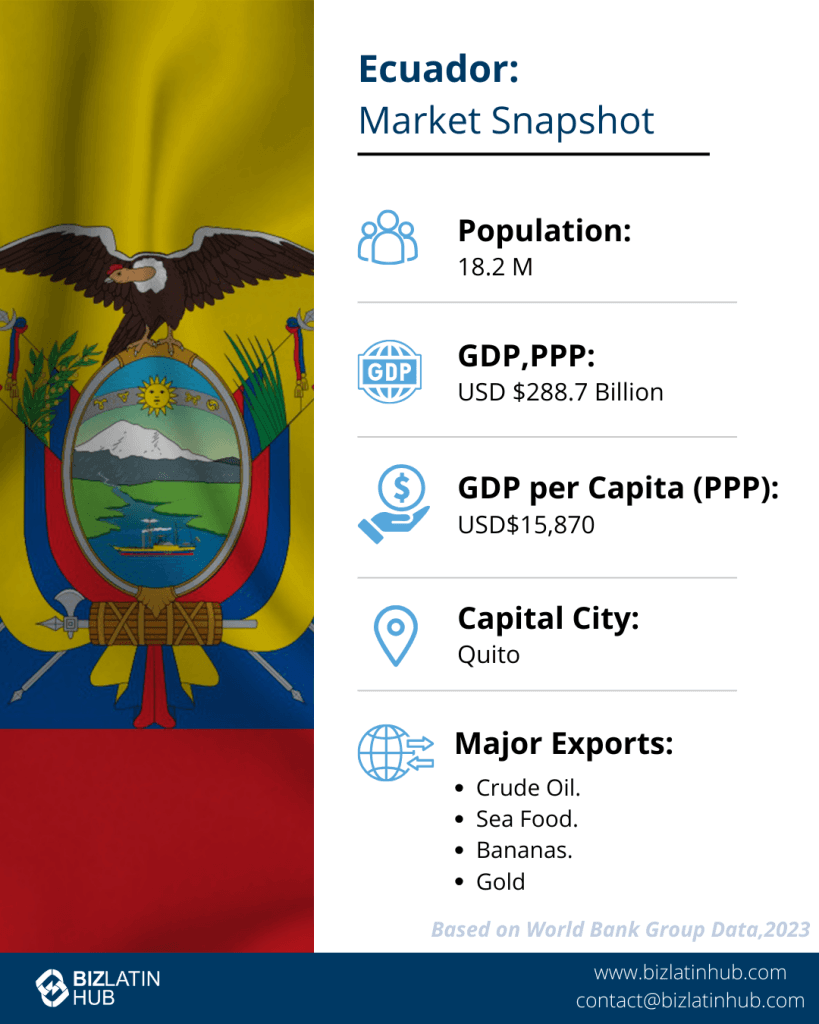
In 2024, Ecuador’s Gross Domestic Product (GDP) was valued at approximately USD$115.05 billion. This represents an increase from the $109.167 billion reported in 2022.
In terms of Foreign Direct Investment (FDI), the latest available data is from September 2023, which shows that Ecuador received an increase of USD$155 million in FDI.
The incorporation process usually takes around one to two weeks, depending on various factors such as the complexity of the company structure and the efficiency of the registration authorities.
Investors seeking to set up a company in Ecuador can choose to establish both limited liability and unlimited liability companies. This can be done online or by following the normal offline process.
We recommend using the online process because it is a lot easier and faster, and transfers a significant amount of the workload to the authorities.
Do You Want to Form a Company in Ecuador?
If you have any questions or inquiries about how to set up a company in Ecuador, our local Ecuadorian business experts have created a company formation presentation.
If you have any more questions about how to incorporate your company in Ecuador, please do not hesitate to contact us now. Our Biz Latin Hub team in Ecuador includes local and expat professionals who have the knowledge and expertise to support you throughout the process.

Share this guide



Let’s talk about your expansion
Tell us which markets you’re entering and what you need handled. A local specialist will map out your options — no obligation.
Trusted by teams expanding across Latin America and the Caribbean
