Tax & Accounting
Why do you need tax advisory services in Ecuador?
Published dateOctober 21, 2024
Last updateOctober 21, 2024
Reading time8 minutes
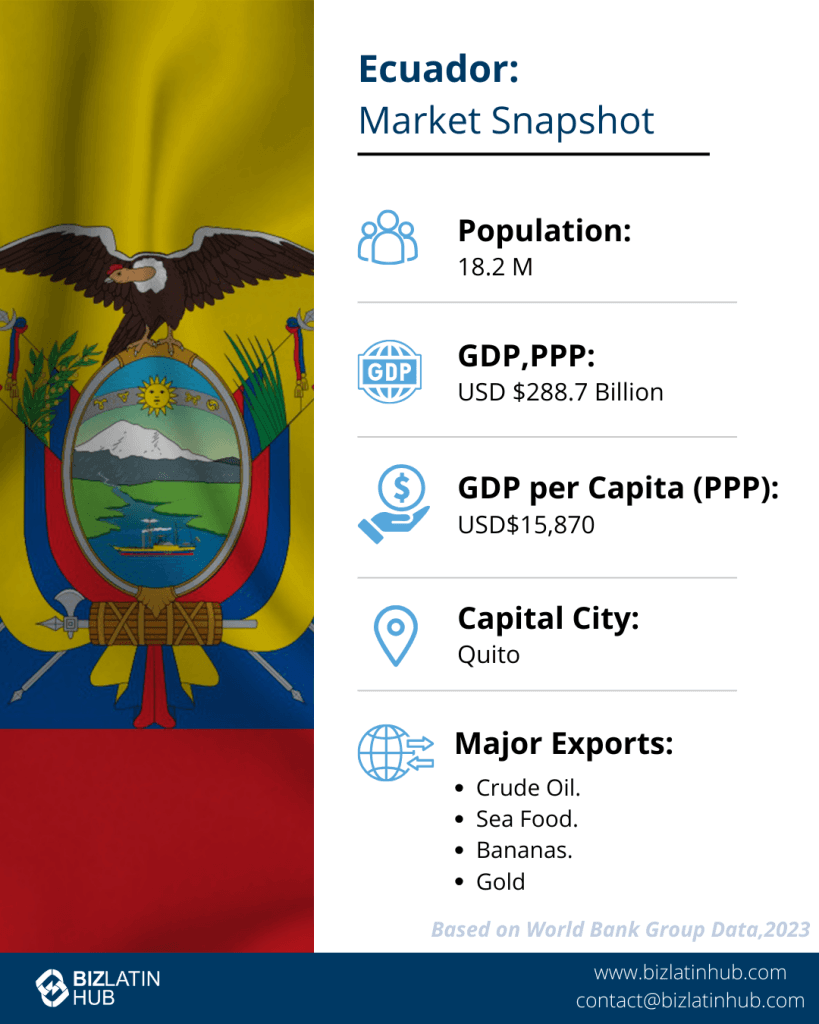
Inevitable though they might be, taxes do not have to be scary. For international investors who want to set up a company in Ecuador, it makes sense to consult taxation professionals to make sure you are within the law of the land.
Inevitable though they might be, taxes do not have to be scary. For international investors who want to set up a company in Ecuador, it makes sense to consult taxation professionals to make sure you are within the law of the land. That’s where you need to look at tax advisory services in Ecuador.
As the country’s economy grows, it is naturally attracting more and more international interest. Along with that comes increasing professionalism and more necessity for tax advisory services in Ecuador. While the country is broadly in line with global norms, there are some local specifics that you should understand.
At Biz Latin Hub, we know all about tax advisory services in Ecuador, thanks to our dedicated local office in the country. Not only that, but our market leading array of back-office services can give you ongoing support in all fields. With our team in your corner, you can relax in the knowledge you’re fully compliant and focus on what you do best – growing your business.
What are the main 4 tax advisory services to be considered in Ecuador?

Generally speaking, the four most important services that international investors are looking for in Ecuador are the following:
- Tax Planning
- International Taxation
- Corporate Taxation
- Tax Controversy and Dispute Resolution
Tax Planning
This involves looking for and then taking advantage of, schemes and incentives for certain industries and/or regions. In Ecuador, these are generally found in the capital, Quito. Also known as ZEDE, the special economic development zone is an interesting project and has allowed for the stimulation of economic development. ZEDE aims to be the ideal destination for the development of new and innovative investment projects.
This zone will create opportunities which will allow for the expansion of production and the development of new products and services. In addition, it provides an ideal zone for value-added production. It will conveniently offer a single location that meets logistical needs while also providing cost reduction, international competitiveness, trade, and tax benefits.
Due to a heavy reliance on its oil sector (where profits are directly linked to international oil prices), the government has developed this program to stimulate other sectors. By stimulating these sectors the government aims to not only stabilise the national economy but strengthen it, ensuring that there is not an over-reliance on a single sector. ZEDE’s main investment incentives include:
- Tax Benefits: ZEDE offers businesses a deduction on income tax and Value-Added Tax (VAT/IVA).
- Remittance Benefits: The program entitles entities to exemption from remittance charges.
- Connectivity: Being strategically located close to Quito airport, the ZEDE program allows international businesses easy access to their projects.
- Benefits of Capital: The program offers benefits for providing social capital for companies.
- Customs Benefits: Foreign trade taxes will be reduced when operating under the umbrella of ZEDE.
International Taxation
This involves looking at how a legal entity in Ecuador will interact with businesses in other countries, or to investors and shareholders abroad. Here we are mainly talking about withholding taxes and double taxation agreements.

The Ecuadorian tax system is friendly for foreigners since they are only taxed on income earned within Ecuador. The country is part of the Andean Community (CAN), which also includes Bolivia, Colombia and Peru. In 2004, an agreement to eliminate double income taxation was signed by CAN. Only citizens, residents or companies legally established in any of the member countries can access those benefits.
Argentina, Brazil, Chile and Mexico have all also maintained double taxation agreements with Ecuador for more than a decade. The most recent of Ecuador’s double taxation agreements to be signed with a Latin American country was with Uruguay in 2013.
Ecuador signed a double taxation agreement with China in 2015. The agreement includes gains derived from the sale of real estate or movable property, and taxes on the total amount of wages paid by companies. Over recent years, trade between Japan and the Andean nation has also increased, and Ecuador’s double taxation agreement with the Tokyo government was signed and came into force in January 2020.
The Foreign Money Transfer Tax (ISD) or Capital Outflow Tax applies to all monetary transactions and operations which are carried out abroad in a foreign currency. The applied tax rate is 3.5% and has to paid by all foreign and local companies, as well as all individuals and foreign banks when doing monetary transactions.(1)
Corporate Taxation in Ecuador
Company structure may significantly affect tax liabilities and responsibilities. That’s why it’s necessary to consider the correct set-up for your organization, depending on what exactly you want to do in the country, how large your company is and if you will be working internationally.
All companies that reside in Ecuador, are incorporated in Ecuador, or have operations and a management center in Ecuador are subject to a corporation tax rate of 25% on their worldwide income, and have discounts when disabled or senior staff are hired. Companies which are non-resident in Ecuador (all companies not incorporated in Ecuador) only have to pay income on their income sourced within Ecuador.
The end of the Ecuadorian tax year is the 31st of December and taxes must be filed in April, the exact date depends on the 9th digit of the Ecuadorian tax identification number.
The tax from which most income is generated in Ecuador is IVA, which is the Ecuadorian Value Added Tax. Currently, the tax rate for the IVA is 12% and is paid on almost all purchases of goods, imports and the provisions of services, with some exemptions at 0%.
VAT returns must be filed monthly, between the 10th and the 28th of the following month of the transaction – the exact day depends on the company’s tax identification number, RUC.
Tax Controversy and Dispute Resolution
While most of this is relatively straightforward and unlikely to present issues, from time to time disputes and errors can occur. That’s where you will really need good tax advisory services in Ecuador. First off, you need to know who the relevant authority is, which is the Servicio de Rentas Internas (SRI). Related to this are audits, which can help identify problems before they occur.

In Ecuador, International Financial Reporting Standards (IFRS) are applied and financial statements must be submitted annually to the Internal Revenue Services and the superintendence of companies. They have three years from the date of filing to review tax returns and make changes if deemed necessary. If a tax return was filed incomplete or not at all, the period of review can be extended for up to 6 years.
If the tax is paid late, penalties have to be paid for late payment at a fixed rate of 3% of the value of the tax generated, for each month of delay. In addition, a penalty of USD$30 to USD$60 must be paid for not having declared the tax on the due date.
If taxes have been filed incorrectly, a “substitute form” must be filed as determined by the Internal Revenue Service (SRI) for each year.
FAQs on tax advisory services in Ecuador
Biz Latin Hub can provide tax advisory services in Ecuador
At Biz Latin Hub, we provide integrated market entry and back-office services throughout Latin America and the Caribbean, with 18 offices in major cities across the region. We also have trusted partners in many other markets.
Our unrivaled reach means we are ideally placed to support multi-jurisdiction market entries and cross border operations.
As well as knowledge of tax advisory services in Ecuador, our portfolio of services includes hiring & PEO, ongoing accounting & taxation, company formation, bank account opening, and corporate legal services.
Contact us today to find out more about how we can assist you in finding top talent, or otherwise do business in Latin America and the Caribbean. Or read about our team and expert authors.

Share this guide




Let’s talk about your expansion
Tell us which markets you’re entering and what you need handled. A local specialist will map out your options — no obligation.
Trusted by teams expanding across Latin America and the Caribbean
