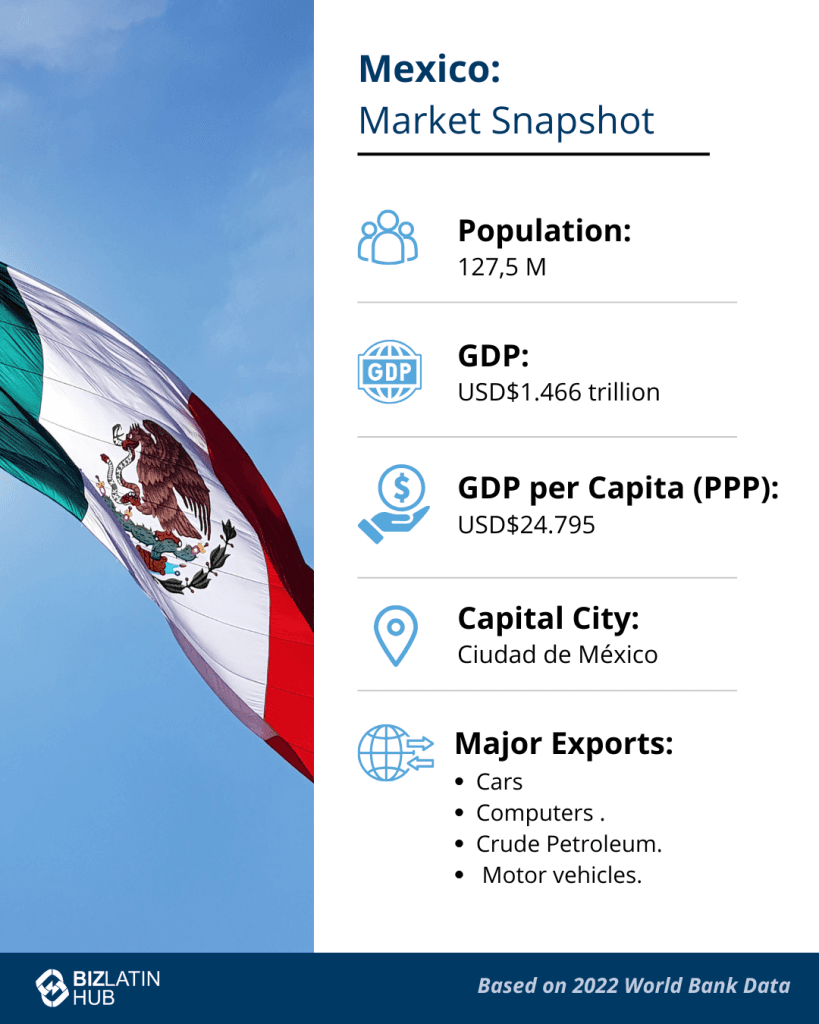
Considered the second-largest economy in Latin America and the fourteenth-largest worldwide, Mexico is a country full of opportunity. The country’s leading trading partner is the United States, accounting for 80% of Mexico’s exports and 49% of its imports.
Considered the second-largest economy in Latin America and the fourteenth-largest worldwide, Mexico is a country full of opportunity. The country’s leading trading partner is the United States, accounting for 80% of Mexico’s exports and 49% of its imports. In 2022, Mexico’s exports were valued at 625 billion, and imports were valued at 604 billion. The country’s high level of trade is supported by its strategic location and the signing of robust trade agreements. All this means the decision to register a cargo airline in Mexico continues to look like a promising venture.
Over recent years, Mexico has succeeded in attracting increased levels of foreign direct investment (FDI), allowing it to continue to develop its economy. In all of 2023, the country’s FDI reached US$36 billion. A direct consequence of the significant trade flows coming in and out of the country. This updraft is boosting the air freight industry to support the movement of goods making now an opportune moment to register a cargo airline in Mexico.
In this article, we explore the air freight market and outline how to register a cargo airline in Mexico. This information is to help you better understand the implications and opportunities that are offered by cargo airline businesses. This will require the formation of a company in Mexico, a service that we can help you with here at BLH.
Trusted by teams expanding across Latin America and the Caribbean
How to Register a Cargo Airline in Mexico
Air cargo carriers are the most recent in our modern world. For both passengers and cargo, it continues to demonstrate itself as the fastest and most time-efficient way to reach delivery destinations across borders.
The world’s air freight industry is constantly adapting to new technologies and procedures tailored to the demanding standards of the aviation sector, and evolving needs of its users. New aircraft are constantly being introduced into the market, specially designed for cargo travel with differing capacities, types of load, and destinations they can reach.
A global market that continues to expand
Despite a slow-down after the pandemic, global demand for air freight is expected to increase by 5% in 2024, according to the International Air Transport Association (IATA). Freight capacity is measured in available tonne-kilometers of freight (TKPA). Over the next 20 years, growth is expected to average 4.3%.
According to IATA, to continue the excellent progress of recent years, the sector must improve its uptake of digital and other new technologies. These changes will make it possible to transport more varied products under better conditions (such as pharmaceutical products). As more businesses look into nearshoring away from Central-east Asia, the need for transportation of goods is going to increase in importance with few alternatives offering the speed and reliability of air freight.
The Mexican airline cargo transport market
Mexico’s air freight market is regulated and supervised by the Dirección General de Aeronáutica Civil (DGAC). The air freight transport industry in Mexico began in 1921 with the creation of the Compañía Mexicana de Transportación Aérea, Mexico’s first air freight transport company. Since then, Mexican airlines have formed alliances with international companies, introducing opportunities for foreign investors in the air freight transport industry.
According to the latest figures from the DGAC, goods transported by air have represented 33% of all goods in Mexico (807 thousand tons). 60% of the domestic market is occupied by the three most significant companies in the country known as MasAir, AeroUnión & Aeroméxico.
Mexico International Airport (AICM), is the main gateway to the country, supporting more than 581,600 tons of freight movement, 82% of which was international. 47.7% of total goods and products are mobilized by the country’s ten main axes Los Angeles, Frankfurt, Memphis, Paris, Doha, Amsterdam, Luxembourg, and Madrid.
Steps to register your cargo airline in Mexico
As a highly regulated industry, there is a specific procedure and a number of individual requirements for companies looking to establish themselves in Mexico’s air freight industry.
Step 1 – Form your company in Mexico
To establish an airline, whether it is freight or passengers in Mexico, you must necessarily create a company in Mexico. This also applies to foreign companies seeking to establish a branch in Mexico, as they will necessarily have to create a company in accordance with Mexican laws. According to Article 9 of the Civil Aviation Legislation (Ley de Aviacíon Civil), only a concession granted by the Secretariat is necessary to provide the public service of scheduled national air transport, in order to obtain it you will have to prove that you have:
The technical, financial, legal and administrative capacity to provide the service in conditions of quality, safety, speed, permanence and price
The availability of aircraft and other aerial equipment in compliance with technical safety requirements, airworthiness requirements and environmental provisions
The availability of hangars, workshops, the necessary infrastructure for its operation, as well as the trained aeronautical and administrative technical staff for the exercise of the requested concession
Have, either by yourself or through associated Mexican commercial companies, the experience that allows them to remain in the sector and maximize the safety of their operationszx
Once this authorization has been given, you may be insured for scheduled international air transport services provided that you have the authorization of the Secretariat.
When creating your company in Mexico, you will have to choose the legal structure adapted to your future air freight activity. It is generally advisable for an airline seeking to establish itself in Mexico to incorporate as a “Sociedad Anónima de Capital Variable” (S.A. de C.V). Once incorporated, the partners and shareholders will have to draft the company’s articles of association, which includes the company’s name, tax address, corporate purpose, share capital, and other initial documentation. This act of drafting the articles of association must be carried out before a notary in Mexico, who will then register your company in the Mexican Public Trade Register. Once the notary public and the Mexican Public Registry have taken the necessary steps, the creation of your company is officialized in Mexico.
Step 2 – Get the right certification for a cargo airline
Besides, you will need to present the following specific certificates, including:
Certificate of Registration for each aircraft to be included in the permit (the DGAC does not accept temporary documents)
Certificate of Airworthiness: this must be unique for each plane that will be listed on the license
Noise level certificates: these must indicate the aircraft type and serial number
Air Operator Certificate: this must mention the name of the company that will appear on the permit.
Step 3 – Get your Mexico Charter Blanket Permit
This license is granted by the Dirección General de Aeronáutica Civil (DGAC), working under the authority of the Secretaria de Communicaciones y Transportes.
In particular, your company’s insurance policy (or fleet policy for all your aircraft) must include:
The name of the company that appears on the permit must be the same company that holds the insurance
Proof that all employees are paid minimum wage salary in effect according to DGAC rules
An outline of intent for commercial/chartered cargo operations, and under no circumstances for private transactions
a national insurance certificate (Mexican Insurance Policy)
the company’s field of practice: either worldwide, or within Mexican territory.
the expiry date of the permit
Must indicate all aircraft and them civil registration numbers and manufacturer serial numbers for each of them
Additional permit documentation
The DGAC also requires the following information to establish your air freight company in Mexico:
The company’s articles of incorporation: this must be a certified copy with original apostille, and will appear on the license. It must identify the company owner, incorporator or main shareholder with their full address
Operating Specifications Manual (notarized original copy): must identify the name of the company and be up to date. Section D085 must list all aircraft in the firm.
completed copy of Ministry of Transport Form 4507
The PIA manual: this is a manual for the publication of Mexican aeronautical information.
Once all these letters have been sent and their contents validated by the DGAC, you will be able to work as an air cargo transport company in Mexican airspace.
FAQs on how to register a cargo airline in Mexico
Biz Latin Hub can help you register a cargo airline in Mexico
You should now have a better understanding on how to register an air cargo company in Mexico. Still, administrative procedures can be long and complicated, and companies applying to operate in this space should partner with local legal professionals who can support them in their expansion. Let us help you and accompany you throughout your project.
The Mexican team at Biz Latin Hub, a global law firm with local expertise, is here to help new and expanding companies through the market entry process and back-office services so that they have the best start for their activities in the Mexican market.
Thanks to our expertise in Latin American law, we can handle the registration process of your company. Feel free to contact us now.
Learn more about our team and expert authors, and check out our video below for tips on company formation in Mexico.