Latin America has been a growing region for many years, but often bedevilled by a lack of international co operation and highly bureaucratic and protectionist policies in many nations. However, this is all starting to change, with groups like the over 50-year old Andean Community of Nations now taking steps to integrate further and attempt to build stronger bridges between members.
Such moves are not only beneficial to local populations, but also to businesses operating in any of the Andean Community of Nations’ member countries, with integration easing cross-border commerce and operations, as well as facilitating international expansion and company formation within the region.
If you are interested in doing business in the Andean Community of Nations, or are already active there, contact us today to find out more about how we can support you with integrated back-office services. We operate in all four countries as well as former member Chile and more than 20 other countries in Latin America and the Caribbean.
What is the Andean Community of Nations?
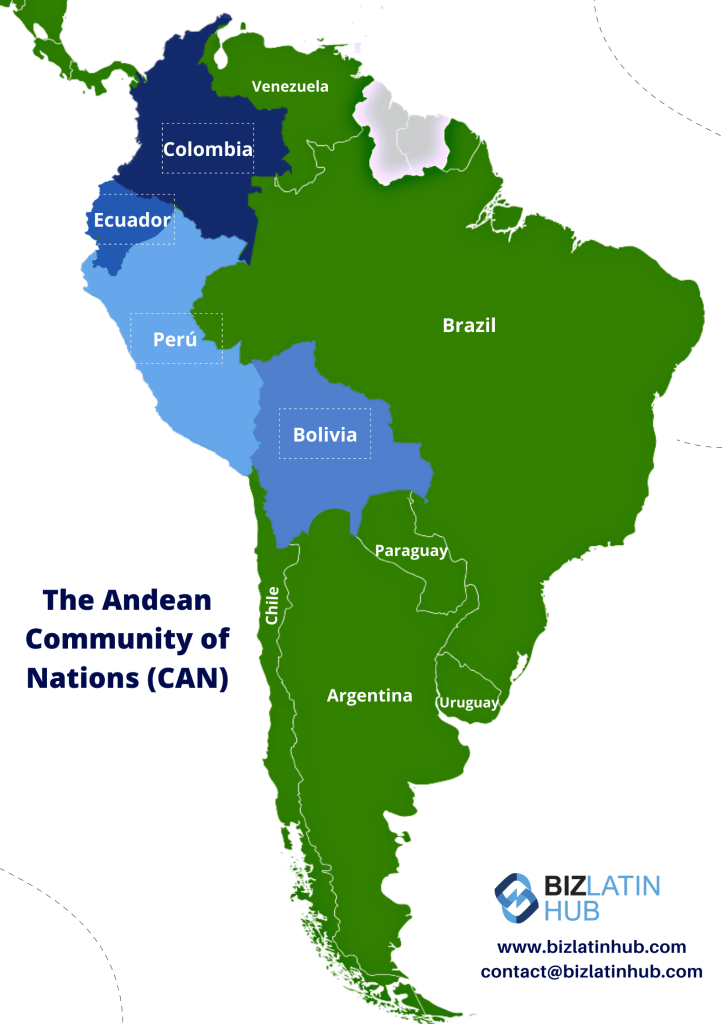
The Andean Community of Nations (CAN) is a regional association that includes Bolivia, Colombia, Ecuador, and Peru that is seeking to deepen integration between members.
Established in 1969 with the goal of implementing a common market based on the European model, the Andean Community aims to bring the economies and populations of its member states closer together.
Chile and Venezuela have each previously been members of CAN, however Chile was excluded three years after the coup in 1973.
Today, Colombia and Peru are associated with Chile via the Pacific Alliance — a decade-old association that also includes Mexico — while Bolivia and Ecuador each have preferential trade agreements in place with the Southern Cone nation.
Meanwhile, Venezuela joined the Andean Community of Nations the same year as the coup in Chile, before leaving in 2006 to join Mercosur — from which it has since been suspended.
While the Andean Community is more than fifty years old, it has recently implemented a number of measures to deepen integration between its members.
3 ways the Andean Community has become more integrated
Recently, a number of measures have been implemented to deepen integration in the Andean Community of Nations, including:
- Increased freedom of movement
In 2021, the Andean Community introduced a new freedom of movement statute — known officially as ‘Decision 878.’ That was declared an “historical landmark” by CAN Secretary General Jorge Hernando Pedraza, despite representing just the latest move to improve mobility among the more than 110 million people living in the four member nations.
Those moves have included the establishment of the Andean Passport — allowing CAN member nation citizens to travel within the region using only their national ID cards.
Decision 878, however, represented the most significant move to free movement to date, providing citizens of any member nation with the opportunity to enter any of the others as a tourist for up to 180 days per year without the need for a visa.
It also provides easier routes to temporary and permanent residency, allowing workers to move between member nations for employment, based on them being able to demonstrate a job or other means to support themselves.
- Regional intellectual property protection
Also in 2021, the Andean Community announced the launch of an intellectual property (IP) database allowing searches of trademarks and brands registered across the four-country sub-region.
Known as ‘CAN TMview’ the database forms part of a European Union-led initiative known as IP Key Latin America, that is intended to develop more stringent IP protection across the region.
Ultimately, IP from all four nations will be easily searchable, with those leading the project highlighting how it is a key part of regional cohesion, as well as encouraging foreign direct investment (FDI), especially from small- and medium- sized enterprises based in the likes of the European Union (EU).
- Mobile roaming charges eliminated
Another big change was that for people moving between the four member states of the Andean Community, mobile roaming charges would be eliminated — echoing a similar measure introduced in the EU a decade ago.
The elimination of roaming charges among CAN countries came into force on 1 January 2022, having originally been agreed as part of Decision 854 in January 2020.
The elimination of roaming charges is overseen by the Andean Committee of Telecommunications Authorities (CAATEL), but only applies to phones used under contract, not pre-paid phones.
Following the recent announcement that CAATEL had approved the implementation of the measure, it was widely celebrated as a major step towards digital integration that would “reinforce Andean identity.”
What does CAN integration mean for doing business?
Deepening integration within the Andean Community of Nations (CAN), comprising Bolivia, Colombia, Ecuador, and Peru, represents one of the most promising developments for businesses and investors in Latin America. The CAN’s commitment to harmonizing trade rules, labor mobility, and intellectual property frameworks is not only good for its citizens, but also for foreign investors and multinational companies operating in the sub-region.
Nearshoring and Cross-Border Business Opportunities
As global supply chains shift toward nearshoring, the Andean Community has emerged as an attractive hub for businesses seeking stability, cost efficiency, and access to a skilled workforce. The ability to move talent seamlessly across member states gives companies unprecedented flexibility, similar to the benefits enjoyed by firms within the European Union.
Enhanced mobility allows professionals in Colombia, Ecuador, Peru, and Bolivia to pursue cross-border opportunities, while companies benefit from a broader pool of qualified talent. This integration supports industries beyond manufacturing and services, including the fast-growing medical tourism sector, which relies heavily on skilled doctors, efficient logistics, and regional cooperation.
A Catalyst for Investment and Market Expansion
Deeper integration is expected to attract more foreign direct investment (FDI), as investors gain confidence in a unified regulatory and trade framework. Companies already operating in one CAN member state are increasingly considering expansion into others, creating a network effect that enhances the region’s overall competitiveness.
This trend is mirrored in the healthcare and wellness industries, where foreign patients are driving demand for advanced, affordable medical procedures across the bloc. For instance:
- Plastic Surgery in Panama demonstrates how regional expertise and competitive costs make Latin America an appealing alternative to North America.
- Dental Tourism in Colombia continues to flourish as patients seek high-quality care with savings of up to 70 % compared to U.S. prices.
- Dental Veneers in Costa Rica highlight the growing cross-regional demand for cosmetic dentistry within integrated Latin American economies.
- Botox in Mexico and Breast Augmentation in Latin America showcase how improved regional mobility benefits both patients and practitioners.
- Orthopedic Surgery in Mexico and Knee Replacement Surgery in Mexico underline the growing strength of the medical tourism ecosystem across the CAN and neighboring states.
Together, these examples illustrate how trade integration, improved infrastructure, and professional mobility make Latin America, particularly the Andean Community, a preferred destination for investment in healthcare, wellness, and technology-enabled services.
Intellectual Property and Regulatory Harmonization
A vital component of the CAN’s integration strategy is intellectual property (IP) standardization, which aims to streamline IP protection and enforcement across all member countries. Over time, the establishment of region-wide IP claims will provide greater legal security for investors, tech innovators, and even healthcare providers launching cross-border platforms.
Meanwhile, the elimination of mobile roaming charges and simplified customs procedures are improving business travel and operational efficiency. These developments are helping the Andean bloc evolve into a unified, investor-friendly market that combines economic potential with regulatory predictability.
Bolivia and Ecuador: Rising Beneficiaries
While all four countries stand to gain, Bolivia and Ecuador are positioned to benefit most from this deepening regional integration. With Colombia and Peru already established as leading investment destinations, expanding harmonization will help the smaller economies draw in greater business attention and capitalize on shared infrastructure, digital trade, and health service exchanges.
Biz Latin Hub can assist you anywhere in the Andean Community of Nations
At Biz Latin Hub, we have offices in Bolivia, Colombia, Ecuador, and Peru, meaning that we are ideally placed to assist you doing business in and expanding within the Andean Community of Nations.
Our comprehensive portfolio of back-office services includes company formation, accounting & taxation, legal services, visa processing, and hiring & PEO, and can provide tailored packages of integrated services to suit every need.
With teams in place in 16 markets around Latin America and the Caribbean, we specialise in multi-jurisdiction market entry and operations throughout the region.
Contact us today to find out more about how we can support you doing business in the Andean Community.
You can also read about our team and expert authors.