
Colombia payroll (nómina) involves calculating, withholding, and disbursing employee wages in compliance with local labor laws and requirements from local tax authority DIAN. Colombia mandates fortnightly or monthly pay cycles and employer contributions of 38-56%. This guide details employer contributions, mandatory deductions and benefits, deadlines, and outsourcing options for payroll in Colombia in 2026.
How do Colombia payroll calculations work?
Employers must make contributions of 38-56% of each employee’s salary monthly in Colombian pesos via the digital platform (PILA) run by the local tax authority (DIAN). This is broken down for all employees as 8.5% in healthcare; 12% to pension funds; 0.522% to occupational risk insurance (ARL); 4% to a family compensation fund; 8.33% in severance (cesantías); 1% interest on severance and 4.17% vacation pay. Employees earning above 10 SMMLV (minimum salary) also require contributions of 2% to occupational education (SENA) and 3% to the national family fund (ICBF).
What payroll taxes do employers pay in Colombia?
| Service | Healthcare | Pension Fund | Occupational Risk | Family Compensation Fund | Severance (incl interest) | Vacation Pay | Governmental Learning Service* | National Family Fund* | Total |
| % of salary | 8.5% | 12% | 0.522% | 4% | 9.33% | 4.17% | 2% | 3% | 38-56% |
*only for employees earning over 10SMMLV
What is the mandatory minimum wage in Colombia for 2026?
Colombia payroll features a monthly minimum wage for 2026 of COP$1,750,905 (aprox USD$465). All Colombia payroll processes must pay at least this rate for full time work, or pro rata for part time hours. There is also a transport subsidy of COP$250,000, bringing the full rate to COP$2,000,000 (aprox USD$525). This is currently under judicial review. The figure has increased over the past few years, as well as a significant appreciation in the exchange rate against the US dollar. The minimum wage rate usually increases in January of each year, although this is subject to political decision.
| 2024 | 2025 | 2026 |
| COP$1,300,000 | COP$1,423,500 | COP$1,750,905 |
| COP$270 | USD$330 | USD$465 |
What are the required steps to set up Colombia payroll?
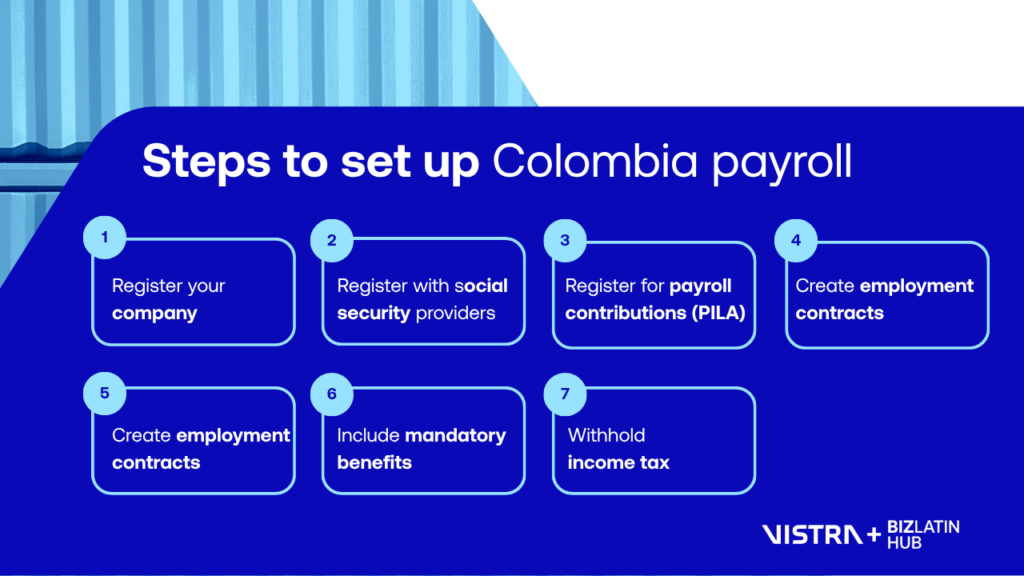
First of all, for Colombia payroll compliance you must incorporate a company in Colombia, then register as an employer, as well as maintain records and file monthly reports. It requires you to not only incorporate a company in Colombia but also spend a significant deal of time handling administrative compliance.
What is Required to Register as an Employer in Colombia?
First, you will need to incorporate a company in Colombia in order to complete Colombia payroll processes. The steps to incorporate a company in Colombia require registration with the tax authority DIAN to get a tax number (RUT) and with the local chamber of commerce. This will allow you to make the monthly payments mandated by DIAN. The full process of incorporating a company in Colombia usually takes between 4 to 6 weeks.
You must also register your business with the Family Compensation Fund, the Colombian Family Institute, and the Governmental Learning Service, and fill out a unique form for all these agencies. You will also need to register your employees for public health coverage. Your company must also affiliate itself with a pension system. There is also registration with the Labor Risks Administrator. This agency helps in covering professional illness and workplace injury cases.
What Payroll Records Must Employers Maintain?
Colombia payroll requires employers to keep records of contracts, payslips and tax filings that are produced for each employee. You will also need to track all social security contributions that are made on behalf of the employee. This includes receipts from the PILA platform. This information must match the records that DIAN has, both from the employee’s tax records and your corporate tax records.
As each employee will have a range of affiliations for healthcare, pension and ARL, you will need to request these and then keep the documentation on file for the duration of their contract with you. Any changes must be annotated, recorded and filed. Penalties for non-compliance can be up to 5,000 SMMLV (COP$8,750,000,000 / USD$2.3mn).
How Often Must Employers File Payroll Reports?
| PILA and electronic payroll | Monthly |
| Exogenous reporting | Annually |
| Severance interest | Jan 31 |
| Severance deposit | Feb 14 |
How Do You Calculate Net Pay in Colombia?
In order to calculate net pay for Colombia payroll, you will need to discount the withholding obligations from gross pay. The employer holds back 4% for pension contributions and a further 4% for healthcare contributions. This is deducted directly from source (gross pay).
For example, an employee being paid COP$3,700,000 (aprox USD$1,000) will have 8% deducted directly from pay, half of which goes to health and half to insurance. This is COP296,000, leaving them with COP$3,404,000 (USD$920) as net pay.
What Mandatory Benefits Must Employers Provide in Colombia?
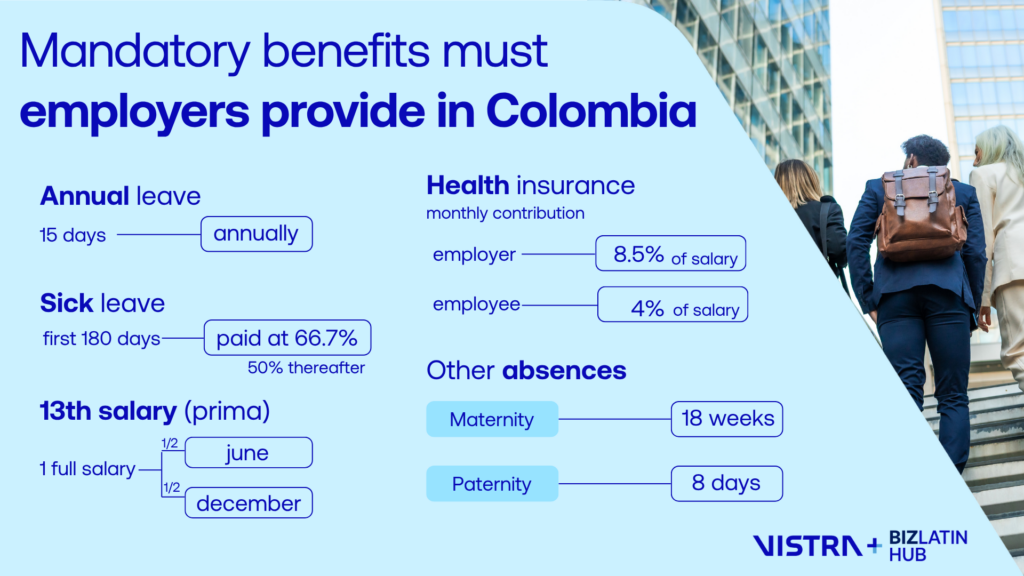
| Vacation days | 15 annually |
| Sick leave | Paid at 66.7% for first 180 days, 50% thereafter |
| Maternity/paternity | 18 weeks / 8 days |
| 13th Salary (prima) | 1 full salary, paid half in June; half in December |
| Severance | 30 days of salary for the first year of service and 20 days for each additional year pro rata, plus payment of accrued severance (cesantías) and all accrued benefits pro rata. |
| Health insurance | Monthly contribution of 8.5% of salary (employer) and 4% of salary (employee) |
How Do You Calculate Overtime Under Colombia Payroll Law?
Normal overtime rates under Colombia payroll law are paid at 25% above the standard rate. However, this is increased to a 35% premium for night shifts (19:00-06:00). Sundays and public holidays currently carry an 80% premium, increasing to 90% in July and finally to 100% in July 2027. The rates are cumulative.
Therefore, the overtime rate varies between 25-115% on top of standard salary depending on the time at which it is served, rising further later this year and again in the following year. This means total pay for a worker earning COP$37,000 (USD$10) per hour could be COP$79.550 (USD$21.50) per hour on a Sunday evening. There is a cap of two hours per day and 12 weekly, as mandated by Ley 2466 de 2025.
What Are the Rules for Employee Termination and Severance in Colombia?
Termination can be for just cause or without just cause, the latter requiring significant severance pay for Colombia payroll compliance to be observed. Just cause is invoked for the usual reasons such as serious misconduct, unexplained absence or criminal/violent behaviour as defined by Article 62 of the Labor code (.pdf).
Severance indemnity for termination without just cause is equivalent to 30 days of salary for the first year of service and 20 days for each additional year or proportional fraction thereof (applicable to employees earning up to 10 minimum monthly legal wages), plus payment of accrued severance (cesantías) and interest on severance, accrued and unused vacation, and proportional service bonus (prima de servicios).
How Do Payroll Tax Treaties Affect Foreign Employers in Colombia?
Colombia payroll duties can include foreign reporting on tax and accounting in Colombia. This applies for fiscal residents who are taxed on worldwide income or by international taxation (residents of Eritrea or the USA, for example). This allows for a tax credit equal to the taxable salary equivalent paid in Colombia. For tax and accounting in Colombia, residency is triggered after a stay of 183 days or more within a 365 day period. Colombia has double taxation treaties with the following countries: Bolivia; Canada; Chile; Czechia; Ecuador; France; India; Italy; Japan; Mexico; Peru; Portugal; South Korea; Spain; Switzerland; United Kingdom. More information about tax and accounting in Colombia can be found on our dedicated page, including Colombia payroll taxes.
When Should You Consider an EOR Instead of Running Payroll Directly?
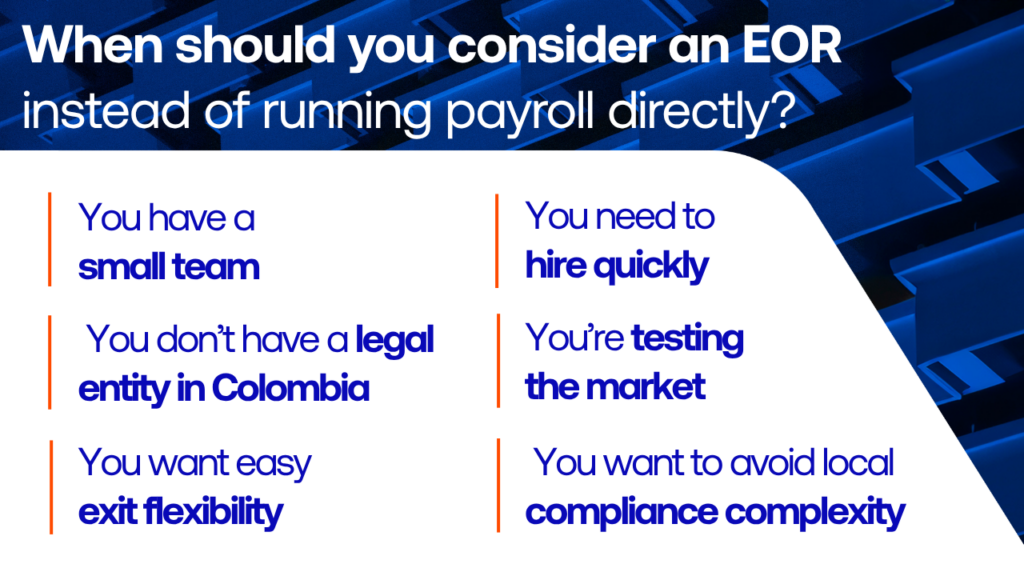
An EOR or Employer Of Record in Colombia will allow you to enter the market much quicker and guarantee Colombia payroll compliance from the start of operations. When entering the market and hiring in Colombia, there are essentially two options available to investors and entrepreneurs. The most common way of doing so is through full company formation to establish a presence in the jurisdiction. However, this may take time and effort, meaning that it is worth considering using an Employer of Record in Colombia.
For businesses planning sustained operations or building a local team of any size, establishing a legal entity in Colombia is the most strategic and sustainable approach. It gives you direct control over employment contracts, builds trust with local talent, and strengthens your brand presence in the country. An Employer of Record in Colombia is useful for companies that want to hire quickly, test the market, or take on short-term contracts without establishing a local company. Under this model, your employees are officially hired through a local subsidiary while you retain management control and critically, remain compliant with Colombia payroll law.
How Can a PEO Help Manage Payroll in Colombia?
A Professional Employer Organization, or PEO in Colombia can make sure you stay compliant by managing your payroll, although you will still have your own legal entity. While an EOR provides a quick-entry solution for testing the Colombian market, establishing a legal entity and working with a PEO in Colombia typically offers greater control, long-term cost efficiency, reduced permanent establishment risk, stronger legal standing, and better talent attraction. A PEO in Colombia functions similarly to an Employer of Record (EOR), though the two terms are often used interchangeably. Many providers also market themselves as PEO payroll companies because Colombia payroll services are among their most in-demand services. A PEO handles a broad spectrum of employee-related responsibilities, including drafting legally compliant contracts, managing statutory leave allowances, ensuring accurate salary and bonus payments, and maintaining compliance with tax and social security obligations.
What Happens If You Report Colombia Payroll Wrongly?
There are significant consequences for reporting Colombia payroll incorrectly, including the potential for fines in excess of USD$2,000,000 and criminal prosecution. Fines are calculated using multiples of the minimum salary (SMMLV) and go up to 5,000 SMMLV. This is currently COP$8,750,000,000 (aprox. USD$2.3mn).
PILA and electronic payroll deadlines must be followed strictly. These vary according to your NIT (unique tax number) and late filing will incur interest, overdue fines and eventually an increased risk of audit. If cesantías are not kept up to date, backdated interest will be applied with additional overdue fines.
Failure to adhere to the benefits mandated by Colombia payroll law (such as not paying the prima correctly) exposes you to legal action from employees, reputational damage and in extreme cases can result in criminal liability for directors. Any unpaid benefits or overtime pay will have to be back-paid.
How Can BLH Help You Manage Colombia Payroll?
Biz Latin Hub can provide Colombia payroll services either through outsourced PEO/EOR or via our company formation back-office suite. We provide integrated market entry and back-office services throughout Latin America and the Caribbean, with offices in key cities around the region, including Bogotá. As local specialists, we know the law inside out and will make sure your company stays fully compliant and free from risk concerning Colombia payroll.
Our portfolio includes not only initial company formation but also accounting and taxes, due diligence, hiring and PEO, and corporate legal services, while our unrivaled regional presence means we are ideally placed to support multi-jurisdiction market entries and cross-border operations. That means we can handle not only Colombia payroll operations but anywhere else in the region as well.
If you need assistance with Colombia payroll, we are ready to help. Contact us today to find out more about what we can do for you.
Frequently Asked Questions About Colombia Payroll
Yes, you can. However, it must be done through EOR services if you do not have a fully registered legal entity that can run Colombia payroll.
It depends on the severity of the offence as well as previous history. A first mistake on Colombia payroll is likely to be treated leniently, especially if minor, whereas persistent non-compliance can lead to significant fines which can be over USD$2 million.
There are three options: direct hiring through a local entity; PEO payroll processing; EOR outsourcing. The latter is the fastest and most agile way to employing, but the former two are better suited for long-term Colombia payroll operations.

Related Posts

Nearshoring in Mexico: A Strategic Guide for U.S. Investors

Vistra acquires Biz Latin Hub, strengthening its Latin American presence and driving growth in the Americas

Renewable Energy Investment in Latin America: Navigating Sustainable Opportunities